
Best VPS hosting in 2026: 8 providers compared

Updated November 10, 2026 · US buying context · Independent third-party benchmarks
Finding the Best VPS hosting depends on more than raw performance. Server management, technical expertise and long-term costs all shape the right choice. ScalaHosting stands out as the managed option worth considering first, while Hostinger KVM 2 offers a more affordable alternative for teams comfortable managing Linux. DigitalOcean, Vultr and Kamatera cater to infrastructure-focused projects, whereas Akamai Cloud (Linode) provides a straightforward cloud hosting option. Hetzner delivered strong results in a European test region, while Contabo offers budget-friendly capacity but raises reliability concerns after recording the only failed requests in the cited eight-provider load test.
These are editorial recommendations, not results from HostChoices-owned servers. Price comparisons distinguish offers verified on November 10 from historical records that still require checkout confirmation.
Quick picks: which VPS should you shortlist?
| Rank | Decision | Provider | Why it makes the shortlist |
|---|---|---|---|
| 1 | Best overall managed VPS | ScalaHosting | Strongest result in the matched load test; managed service and offsite backups. Check the renewal cost. |
| 2 | Best balanced value for Linux-capable buyers | Hostinger KVM 2 | 8 GB RAM, 2 vCPU, $8.79/mo on a 24-month term; renews at $14.99/mo. |
| 3 | Best developer platform | DigitalOcean | Predictable monthly caps, per-second billing and a mature API/tooling ecosystem. |
| 4 | Best for choosing a specific city | Vultr | Broad location selection and High Frequency NVMe plans; verify plan availability in the target region. |
| 5 | Best configurable cloud | Kamatera | Custom resource sizing and hourly/monthly billing for teams that operate their own stack. |
| 6 | Best stable general-purpose cloud | Akamai Cloud (Linode) | 4 GB plan, clear published pricing and 99.99% uptime in the independent 54-day sample. |
| 7 | Best EU performance for Linux experts | Hetzner | Strong independent Frankfurt result; a June US price schedule is available, but check live checkout and IPv4 charges. |
| 8 | Best low-cost lab capacity | Contabo | Inexpensive 8-GB listing in a dated third-party record; weakest response and only failures in the matched test. Official checkout not confirmed. |
Evidence status: what was and was not tested
HostChoices did not provision or benchmark these servers. Performance data come from ThatMy’s September 2026 independent eight-plan comparison, which tested a WordPress site on one configuration per provider, probed from ten cities, ran a 0–250-client load ramp and tracked uptime for 54 days. The source is an affiliate-supported publisher, so its test is useful independent evidence but not a substitute for reproducible measurements on your own workload.
Test plans were not hardware-identical and were deployed in two different regions. The benchmark and the price-reference plans also differ in several rows. Read performance results as observations of the named test instances, not guarantees for an entire provider’s fleet.
Read the independent eight-plan VPS comparison and test methodology for the full plan notes and measurement caveats.
Selection rule: these eight providers had completed plan-level measurements in the same ThatMy comparison. IONOS and InterServer appeared in that source’s broader shortlist but had no matching results there, so they are not assigned a benchmark rank here.
The independent benchmark method and its limits are documented in the ThatMy.com methodology page. Provider prices and billing assumptions are summarized in the comparison tables and source appendix.
Independent cross-checks. VPSBenchmarks’ 2026 annual page, dated November 1, currently reports 270 trials from 72 providers. AIMultiple’s November 5 benchmark ran roughly 1,200 CPU, memory, disk and network tests per server on six 4-vCPU/8-GB plans; its CPU table reports 14,493 events/s for Hetzner, 6,133 for Linode and 3,408 for DigitalOcean. Those are different workloads and configurations, so these figures are not combined with ThatMy’s web-response results or used as a second head-to-head ranking.
Independent performance comparison
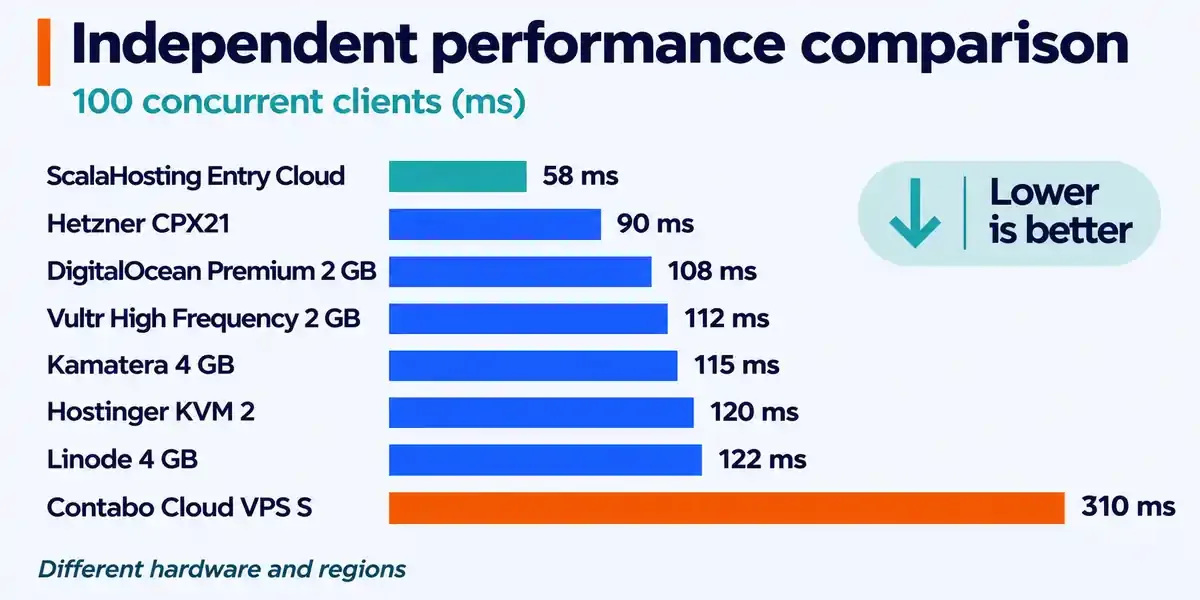
The table reproduces ThatMy’s readings for the named test configurations. Lower response times are better. “100 clients” refers to the response time recorded at one step of a load ramp, while the failure percentage covers the entire 0–250-client ramp. Uptime is measured over a single 54-day observation period, not a contractual SLA.
| Provider / tested plan | TTFB from New York | 100 users | Failed requests (full 0–250 ramp) | 54-day uptime |
|---|---|---|---|---|
| ScalaHosting Entry Cloud | 38 ms | 58 ms | 0% | 99.99% |
| Hetzner CPX21 | 110 ms | 90 ms | 0% | 99.96% |
| DigitalOcean Premium 2 GB | 56 ms | 108 ms | 0% | 99.96% |
| Vultr High Frequency 2 GB | 51 ms | 112 ms | 0% | 99.979% |
| Kamatera 4 GB | 52 ms | 115 ms | 0% | 99.94% |
| Hostinger KVM 2 | 141 ms | 120 ms | 0% | 99.97% |
| Akamai / Linode 4 GB | 62 ms | 122 ms | 0% | 99.99% |
| Contabo Cloud VPS S | 224 ms | 310 ms | 0.61% | 99.91% |
Geography limits these comparisons. Hetzner, Hostinger and Contabo were tested on Frankfurt servers, while the other five servers were in New York. New York TTFB therefore crosses the Atlantic for the Frankfurt group. In the load ramp, the publisher used EU-West for the Frankfurt servers and US-East for the New York group, so the load results are same-continent tests but not hardware-controlled ones. This was a WordPress page test, not a WooCommerce checkout or a sustained multi-minute stress test.
How we ranked the providers
Our order is a practical shortlist, not a mathematical score. We consider load response and errors; management responsibilities; transparent prepaid and renewal costs; deployment options; and data-center geography. These criteria are not reduced to an artificial composite because the benchmark machines, server regions and price-reference configurations differ.
- Managed operations: ScalaHosting suits owners who need server support; included scope still needs contractual review.
- Self-managed value: Hostinger pairs an 8-GB configuration with a documented 24-month introductory and renewal schedule.
- Developer workflows: DigitalOcean and Vultr offer cloud-style deployment; Kamatera emphasizes configurable resource sizing.
- Context-specific choices: Akamai Cloud is a straightforward baseline; Hetzner is compelling when region and price align; Contabo is better treated as a test-environment candidate until a workload-specific trial succeeds.
Affiliate availability does not determine the order. Because parts of the November 10 price audit are unresolved, do not treat the order as an exact cost-adjusted league table.
Benchmark plans versus price-reference plans
A benchmark result belongs to the plan actually measured. A price belongs to the plan and region actually quoted. These distinctions prevent a fast 2-GB instance from being presented as test evidence for an 8-GB plan.
| Provider | Plan benchmarked | Price-reference plan | November 10 verification status |
|---|---|---|---|
| ScalaHosting | Entry Cloud | Managed Cloud Build #1, 2 vCPU / 4 GB | Official offer and renewal visible; different plan |
| Hostinger | KVM 2 | KVM 2, 2 vCPU / 8 GB | Official offer and renewal visible |
| DigitalOcean | Premium 2 GB | Basic 4 GiB, 2 vCPU | Official monthly cap visible; different plan |
| Vultr | High Frequency 2 GB | High Frequency 4 GB | Third-party October record only; live official page inaccessible |
| Kamatera | Cloud 4 GB | Pro 4 GB / 2 vCPU record | Third-party November 6 record only; live configuration quote unavailable |
| Akamai Cloud (Linode) | Linode 4 GB | Shared CPU Linode 4 GB | Official monthly price visible |
| Hetzner | CPX21 in Frankfurt | US CPX21 | Official June adjustment schedule found; live US checkout not confirmed |
| Contabo | Cloud VPS S | Cloud VPS 4, 4 vCPU / 8 GB | Third-party November 6 promo record only; official checkout inaccessible |
Direct provider pages and the remaining checkout caveats appear in the individual reviews and in the cost comparison below.
Why server location can outweigh a small spec difference

Response times depend on both server speed and geography. ThatMy’s New York, Frankfurt and Singapore probe-to-server timings were gathered against servers in different locations, so they should not be treated as a controlled same-region comparison. For example, the Hostinger Frankfurt test server took 56 ms from Frankfurt and 141 ms from New York. This is a location effect, not proof that Hostinger is inherently slow for US buyers.
For a primarily US audience, start with a nearby US region unless data dependencies require another location. Canadian audiences should compare nearby Canadian and US options using their own traces. A CDN improves delivery of cacheable assets; origin distance still matters for authenticated pages and database-backed requests. For a broader interpretation of server tests, see how HostChoices evaluates hosting speed measurements.
Provider-by-provider verdicts
1. ScalaHosting — best overall for managed VPS
ScalaHosting is the strongest choice when the goal is to run a revenue-producing site without taking full ownership of server operations. In the independent WordPress comparison, its Entry Cloud plan returned 38 ms from the New York probe and 58 ms at 100 concurrent users, with 0% failed requests across the full 0–250 client ramp and 99.99% uptime over 54 days. That was the best 100-user result in the eight-plan sample.
ScalaHosting lists SPanel, automatic offsite backups, application support, free application installation and migration, SSL and real-time malware protection for the visible managed-cloud offer. Unlike unmanaged compute, this service bundles operational help, but the exact patching and incident-response responsibilities should be checked in the agreement.
Price and configuration: On November 10, the official managed-cloud page shows a Black Friday promotional Build #1 at $22.46/month equivalent on a selected 12-month term, renewing at $54.95/month. The page exposes 2 CPU cores, 4 GB RAM and 50 GB NVMe storage with offsite backups. Twelve introductory months require $269.52 before any tax; a 36-month service projection at the posted renewal rate is $1,588.32, assuming the same 12-month renewal price is available for two subsequent years. The independently benchmarked Entry Cloud is a different named plan. Confirm the final invoice and renewal billing before ordering.
Evidence limit: The 58-ms response belongs to Entry Cloud; neither the current Build #1 response time nor support ticket turnaround was tested by HostChoices.
Best for: small businesses, agencies and WordPress owners who value support and managed operations more than the lowest sticker price. Skip it if you have a capable DevOps team and mainly want the cheapest raw compute.
Current offer and included services: ScalaHosting managed cloud pricing
2. Hostinger — best value for buyers comfortable with Linux
Hostinger KVM 2 is the strongest balanced-value choice in this group when you can administer the server yourself. The current US VPS page lists 2 vCPU cores, 8 GB RAM, 100 GB NVMe storage and 8 TB bandwidth. The displayed 24-month rate is $8.79 per month, billed as $210.96 upfront, and the same plan renews at $14.99 per month for another 24-month term. Hostinger also lists weekly backups and firewall management; these tools do not turn the VPS into a managed server-administration service.
The independent test’s KVM 2 instance returned 120 ms at 100 concurrent users, with 0% failed requests across the full 0–250 client ramp and 99.97% uptime over 54 days. The New York probe recorded 141 ms, but that test server was in Frankfurt; its best measured location was Frankfurt at 56 ms. This is a reminder to select the correct data-center region before ordering.
The 36-month service-cost calculation is $210.96 for the first 24 months plus 12 × $14.99 = $179.88, for $390.84 total. The cash commitment can be higher: if renewal is billed as another full 24-month block, the invoice due at month 25 is $359.76, so cash paid by month 36 can reach $570.72. The $179.88 difference is prepaid service for months 37–48, not an additional cost attributable to the first 36 months.
Evidence limit: The same named KVM 2 plan was tested, but infrastructure and pricing can change after a benchmark. The listed weekly backups do not replace independent recovery testing.
Best for: developers, technical site owners and small teams that want a strong resource bundle without managed-VPS pricing. Skip it if you need the provider to own OS hardening, patching, incident response and application troubleshooting; the included backup/restore tooling is not a managed recovery service.
Check the current KVM offer: Hostinger VPS plans and pricing
3. DigitalOcean — best developer platform and predictable billing
DigitalOcean is a good default for developers who value a clear control plane, APIs, documentation and predictable usage-based billing. Its official Basic Droplet price table lists a 4 GiB, 2-vCPU configuration with 4,000 GiB transfer and 80 GiB SSD at $24 per month. Droplets are billed per second with a monthly cap, so short-lived test and development instances can cost less than a full month.
In the independent comparison, a Premium 2 GB Droplet returned 108 ms at 100 concurrent users, with 0% failed requests across the full 0–250 client ramp and 99.96% uptime over 54 days. The benchmarked Premium 2 GB plan is not the same configuration as the 4 GiB price reference used in the 36-month model. At $24 per month, the current 4 GiB plan projects to $864 over 36 months before tax, backups, snapshots, bandwidth overages or other add-ons.
Evidence limit: The 108-ms result comes from a 2-GB Premium Droplet, not the 4-GiB Basic instance used for the price example.
Best for: developers, SaaS teams and workloads that benefit from API-driven infrastructure and flexible instance lifecycle. Skip it if you want a managed server or need a bundled control panel and hands-on application administration.
Current plan details: DigitalOcean Droplet pricing
4. Vultr — best when region choice is a priority
Vultr is worth checking when a specific city matters or when you need to choose between different CPU and storage classes. Its official pricing page did not provide a verifiable live quote on November 10. A third-party price record dated October 25 lists High Frequency at 2 vCPU, 4 GB RAM, 128 GB storage and approximately 3 TB transfer for $24/month, but this is not a November 10 official quote. Verify location stock and price in the Vultr console.
ThatMy measured 112 ms at the 100-client step for a High Frequency 2-GB instance, no failed requests across the full ramp and 99.979% uptime over 54 days. Its 2-GB test result cannot be assigned to the separate 4-GB price-record configuration. A 36-month total based on the older $24 record would be $864 before extras, but that amount is withheld from the verified cost table until the official price is checked.
Evidence limit: The performance result is attributed to one tested server. Neither today’s 4-GB plan rate nor target-city availability was verified on the official site.
Best for: developers and distributed teams whose latency requirement is tied to a specific city. Skip it if you need server administration included or if a low-cost, high-RAM bundle is your main criterion.
Check regional availability and price: Vultr official pricing
5. Kamatera — best for configurable cloud servers
Kamatera is designed for teams that need to select CPU, memory and storage with finer granularity than a fixed hosting bundle. A third-party record verified November 6 lists a Pro configuration with 2 vCPU, 4 GB RAM, 20 GB NVMe and 5 TB transfer at $39/month in its recorded market. A separate VPSBenchmarks Los Angeles trial snapshot listed $42/month for a 4-GB/two-core server on November 7. These are different records, not interchangeable official checkout quotes. A current provider-issued quote for the selected US configuration was not verifiable on November 10, so no 36-month buying total is asserted.
The ThatMy 4-GB cloud-server test returned 115 ms at 100 concurrent clients, no failed requests across the full ramp and 99.94% uptime over 54 days. This web workload is distinct from the trial-list entries and does not validate the newer configurations’ performance.
Evidence limit: The benchmark is single-instance evidence, and a current configuration-specific quote for the chosen US region remains outstanding.
Best for: DevOps teams, SaaS operators and developers who need configurable cloud capacity and understand the cost of their architecture. Skip it if you want a fixed, managed hosting bundle or need a very low-cost entry plan with more RAM.
Review the Kamatera configuration FAQ and request an itemized quote that includes network, storage, backups, public IPs and any management services.
6. Akamai Cloud (Linode) — best steady general-purpose baseline
Akamai’s cloud pricing page lists a Linode 4 GB shared-CPU instance at $24 per month, with 2 vCPU, 80 GB storage and 4 TB transfer. The 36-month projection is $864 at the current monthly rate. The published plan is straightforward to budget, but the instance remains self-managed: operating-system updates, application security, backups and recovery design still need an owner.
The independent Linode 4 GB test returned 122 ms at 100 concurrent users, with 0% failed requests across the full 0–250 client ramp and 99.99% uptime over 54 days. That is a stable result in this sample, though it was not the fastest load response. The test server was in New York, which makes its New York probe figure more relevant to North American traffic than the Frankfurt-hosted test servers in the same study.
Evidence limit: Tested and priced products share the Linode 4-GB name, but observed uptime is not a service guarantee.
Best for: teams seeking a conventional cloud VPS with published pricing and a broad cloud platform behind it. Skip it if you need a managed control panel or expect the provider to own application-level maintenance.
Current shared-CPU plan: Akamai Cloud pricing
7. Hetzner — strong measured performance, but check US pricing and region
Hetzner’s CPX21 plan returned 90 ms at 100 concurrent users with 0% failed requests across the full 0–250 client ramp and 99.96% uptime over 54 days in the independent comparison. That is the second-best load response in the sample. The test server was in Frankfurt, so the result should not be read as a measured US-region response time.
Hetzner’s June 15, 2026 price adjustment covers cloud products. Its publicly indexed official price schedule lists US CPX21 at $37.49 per month, excluding VAT and separately charged public IPv4. This is a dated scheduled price, not a verified November 10 checkout amount. At that fixed reference price, 36 months would total $1,349.64 before other charges; confirm current availability, rate and IPv4 pricing in the US region. The measured CPX21 was located in Frankfurt.
Evidence limit: A Frankfurt web benchmark cannot establish US-region latency or current US hardware performance; the June price schedule also requires a live checkout check.
Best for: experienced Linux administrators who can select the correct region and manage the server themselves. Skip it if you are buying based on a stale European entry price while your workload must run in the United States.
Current US price adjustment: Hetzner’s June 2026 pricing notice. Check the current CPX21 configuration and regional plan information on Hetzner Cloud Regular Performance
8. Contabo — best low-cost capacity for labs and staging
A third-party price record verified November 6 lists a different product, Cloud VPS 4, with 4 vCPU, 8 GB RAM and 100 GB SSD at a promotional €4.40/month equivalent for a 24-month commitment, followed by a listed €5.50/month renewal rate. The record does not confirm an unlimited guaranteed traffic allowance, a promotion end date or final tax treatment. A current official checkout quote could not be obtained on November 10, so the offer is provisional rather than a verified deal.
At the ECB November 10 reference rate of 1 EUR = 1.1214 USD, 36 months of modeled service under those recorded terms cost (€4.40 × 24 + €5.50 × 12) × 1.1214 = $192.43. If a full second 24-month block must be prepaid at month 25, cash paid can reach $266.44, of which $74.01 covers months 37–48. This illustration excludes VAT, addons and transaction FX spreads. It should not be represented as a live US checkout price.
The performance evidence is the reason Contabo ranks last overall despite the low price. Its Cloud VPS S test returned 310 ms at 100 concurrent users and 0.61% failed requests across the full 0–250 client ramp, the only plan in the eight-provider sample with failed requests. Uptime was 99.91% over 54 days. The test is not proof that every Contabo server will behave this way, but it is a warning against choosing the provider for a checkout-critical workload without testing your own application.
Evidence limit: The failed requests were observed on Cloud VPS S, not on the separately priced Cloud VPS 4. Repeat the test on your selected configuration.
Best for: labs, staging, backups, storage-heavy experiments and non-critical services where low cost and high RAM matter. Skip it for a revenue-critical store or application unless a fresh, workload-specific test clears your performance and reliability requirements.
See Contabo’s US-location page and confirm term length, tax, region, fair-use conditions and backup fees in checkout.
The 36-month cost model: service versus cash

Two totals answer different questions. Service cost assigns only the first 36 months to this comparison; cash required counts full prepaid term invoices due during that window. Official prices verified on November 10 are separated below from illustrative or older reference prices. Taxes, add-ons, exchange fees, control panels and future cloud rate changes are excluded.
| Priced plan and evidence | Billing assumption | 36-month service cost | Cash due by month 36 | Key limitation |
|---|---|---|---|---|
| ScalaHosting Build #1 — official Nov 10 | $22.46 × 12; $54.95 × 24 | $1,588.32 | $1,588.32 (modeled) | Black Friday 12-month offer; assumes two 12-month renewals at the advertised renewal rate |
| Hostinger KVM 2 — official Nov 10 | $210.96 for 24 months, then $14.99/mo equivalent | $390.84 | $570.72 if the full renewal term is charged | $179.88 prepays months 37–48; taxes not modeled |
| DigitalOcean Basic 4 GiB — official Nov 10 | $24 monthly cap × 36 | $864.00 | $864.00 (modeled) | Assumes nonstop operation and unchanged rate; extras not included |
| Akamai Cloud Linode 4 GB — official Nov 10 | $24/mo × 36 | $864.00 | $864.00 (modeled) | Assumes unchanged monthly rate and no add-ons |
| Hetzner CPX21, US — official June schedule | $37.49/mo × 36 | $1,349.64 (indicative) | Not checkout-verified | Historical published schedule, no VAT or public IPv4 |
| Vultr High Frequency 4 GB — third-party Oct record | Record: $24/mo | Not verified today | Not verified today | Official live pricing and region stock unavailable |
| Kamatera Pro 4 GB — third-party Nov 6 record | Record: $39/mo; other region trial $42 | Not modeled | Not verified today | Requires a configuration-specific official quote |
| Contabo Cloud VPS 4 — third-party Nov 6 record | €4.40 × 24; then €5.50/mo; ECB Nov 10 FX | $192.43 (provisional) | $266.44 if 24-month renewal prepaid | Official US checkout, taxes and promotion unverified; $74.01 prepaid beyond month 36 |
For Hostinger, $390.84 is the cost of service consumed; the larger $570.72 cash amount reflects paying for months 37–48 when the second 24-month block starts. The Contabo illustration applies the same principle, but its underlying euro offer is only a dated third-party record. The HostChoices cost calculator can model your actual renewal term and add-on costs after checkout is confirmed.
Do not purchase on the basis of the provisional rows. The planned 36-month horizon is not a fixed contract guarantee for pay-as-you-go providers; server price changes, resources, IP charges, taxes, exchange rates and renewal terms can all alter the bill.
Managed VPS vs. self-managed VPS: the hidden cost
A managed plan can look expensive beside an unmanaged server because the bill includes some operational work. A self-managed VPS is not “the same server for less” unless you already have the time and expertise to patch, monitor, secure and restore it.
- If you choose self-managed, price a control panel only if you need one; a cPanel or Plesk license can materially change the cost.
- Price backups and off-server retention separately. A snapshot on the same account is not a substitute for a tested restore path.
- Clarify whether support covers only the host network and hardware or also the operating system, web server, database and application stack.
- If the site handles payments, test recovery and incident escalation before migrating production traffic.
VPS security checklist before production
Root access gives you control, not automatic security. Assign ownership of authentication, OS patching, network exposure, application security and recovery before the server handles customer data. For teams without a full-time administrator, the hosting maintenance scope checklist helps determine which tasks should be contracted out.
- Use SSH keys, disable password login where appropriate, and protect the provider account with multi-factor authentication.
- Apply least-privilege access; avoid sharing the root account with every developer or contractor.
- Expose only required ports; configure host firewall rules and understand the provider’s DDoS protection boundary.
- Keep the OS and application stack on supported versions, patch promptly, and monitor authentication and system logs.
- Back up off-server, define retention and RPO/RTO, and run a restore test on a separate instance before cutover.
Which VPS should you choose? A profile-based decision
| Your situation | Shortlist | Reason |
|---|---|---|
| No in-house Linux administrator | ScalaHosting | Managed support and offsite backup features reduce the operational burden; budget for renewal. |
| Technical owner, small business site | Hostinger KVM 2 | Low 36-month modeled cost and 8 GB RAM; you own server administration. |
| API-driven application or DevOps team | DigitalOcean or Kamatera | DigitalOcean for platform simplicity; Kamatera for custom resource sizing. |
| Audience concentrated in one metro | Vultr | Choose the region first, then verify the exact plan and current local price. |
| EU audience, Linux expertise | Hetzner | The matched benchmark was strong, but choose the EU region and use current local pricing. |
| Lab, staging or low-criticality service | Contabo | Very low current US list price; load evidence argues against assuming it is a production winner. |
| General cloud instance with a clear plan price | Akamai / Linode | Published 4 GB configuration and a steady result in the 54-day independent sample. |
A seven-step VPS buying and migration checklist
- Write down the workload: WordPress, WooCommerce, API, database, game server, development or staging. Estimate peak concurrency, not just monthly visits.
- Choose the server region based on the users and data dependencies. Test latency from the actual customer geography.
- Compare CPU, RAM, storage type, transfer allowance, network port and public IPv4 cost. Do not compare “4 GB” plans without reading the CPU and disk details.
- Classify the plan as managed or self-managed. List who owns patching, backups, monitoring, incident response and application troubleshooting.
- Calculate both 36-month service cost and cash required. Include prepaid terms, renewal billing cycles and the add-ons you will actually use.
- Provision a non-production instance and run your own representative load test: uncached pages, database queries, background jobs and checkout flows if relevant.
- Before cutover, verify backups, restore, DNS TTL, TLS, firewall, monitoring and rollback. Keep the old host until the new environment passes the acceptance test.
Frequently asked questions
What is the best VPS hosting in 2026?
For managed business hosting in this evidence set, ScalaHosting is the strongest overall fit because it combines the best measured 100-user result with managed-cloud features. Hostinger is the best value choice for buyers who can administer Linux. The best answer changes with workload and skill level.
Is managed VPS worth the extra cost?
It can be, when server administration, patching, backups and incident response would otherwise consume paid staff time or create operational risk. Compare the exact management scope, not the word “managed” alone.
How much should I spend on a VPS?
Budget depends on workload, administrative support and billing cycle. The verified example here is Hostinger KVM 2 at $8.79/month equivalent prepaid for 24 months, renewing at $14.99/month equivalent for another 24-month term. Cloud plans such as the verified $24/month DigitalOcean Basic 4-GiB Droplet are billed differently. Include backups, public IPs, tax, control panels and staff time.
Is a VPS faster than shared hosting?
It can provide more predictable resources and root access, but a poorly configured or overloaded VPS can perform worse than a well-run shared plan. Benchmark the actual application and location.
Should I choose NVMe storage?
NVMe can reduce storage latency and raise throughput for disk-heavy tasks, but the application, CPU budget and server location may be bigger bottlenecks. See what NVMe changes in WordPress hosting for a workload-focused explanation.
Can I use a VPS for WooCommerce?
Yes, but the server must handle uncached cart, checkout, search and database activity. The cited independent test used a WordPress site, not a WooCommerce checkout, so run a workload-specific test before migrating a store.
Do VPS providers include backups?
Some managed plans include scheduled or offsite backups; many unmanaged plans require you to configure and pay for backups separately. Check retention, restore fees, storage limits and whether backups are stored outside the server account.
Are the 36-month totals guaranteed?
No. Some rows use November 10 official prices; others are explicitly marked as dated records or provisional scenarios. Monthly rates and promotions may change, and prepaid renewals alter cash needs. Verify your exact plan, region, invoice total and renewal period before purchasing.
Final verdict
For a site whose owner cannot maintain a VPS, ScalaHosting is the leading managed candidate in this comparison: its tested Entry Cloud delivered the strongest 100-client response, and its current Build #1 page lists an operational package. The tested and priced plans are different, however, and the management scope and renewal invoice still need checking. For a Linux-capable team, Hostinger KVM 2 has a documented, relatively inexpensive 24-month offer and a measured result in the middle of the load-test group.
DigitalOcean, Vultr and Kamatera deserve consideration when deployment flexibility or a particular region matters; Akamai Cloud is a conventional reference configuration. Hetzner’s strong Frankfurt result should be matched to the right market and a current quote. Contabo’s recorded price is attractive, but its separately tested configuration had the weakest load response and the only failed requests in the eight-plan sample.
Buying rule: pick the region and management model first, compare exact configurations and full prepaid invoices second, and load-test your application before production migration. The remaining official-price checks must be completed before treating this article’s provisional comparison as publication-ready advice.
Sources and verification links
Performance attribution and commercial verification are deliberately separate. The linked third-party benchmark does not establish today’s checkout prices; dated commercial records are labeled where a provider’s official page could not be independently read.
- ThatMy — eight measured VPS plans, load responses and uptime (September 2026); test methodology
- VPSBenchmarks — 2026 trials summary; AIMultiple — November 5 six-provider CPU and disk study
- ScalaHosting managed cloud pricing; Hostinger VPS pricing
- DigitalOcean Droplet pricing; Akamai Cloud CPU pricing
- Hetzner June 2026 price adjustment; Hetzner cloud configurations
- Vultr official pricing (not independently accessible on November 10); older pricing record
- Kamatera configuration documentation (not independently accessible on November 10); older recorded configurations
- Contabo official US VPS site (not independently accessible on November 10); November 6 recorded offer
- European Central Bank — EUR/USD reference rate, November 10, 2026
Disclosure: This HostChoices edition contains no supplied affiliate tracking links. The linked benchmark publisher has its own affiliate disclosure. The recommendations here are editorial judgments based on attributed external tests; HostChoices did not test these VPS plans directly.