Dedicated server reseller: Essential margin and support checklist

A dedicated server reseller buys bare-metal capacity from an upstream provider and sells it to end customers under its own brand. The reseller may add provisioning, server management, monitoring, backups, control-panel access and support. The model avoids the capital expense of operating a data center, but a headline wholesale discount is not the same as profit.
The commercial decision turns on four questions: what the reseller pays over the full contract period, which tasks it must perform, what the upstream SLA actually covers, and how quickly it must handle abuse or compliance notices. This guide examines public program terms for US and Canadian buyers and uses an explicitly illustrative 36-month margin model. Provider-specific wholesale quotes remain necessary.
The short answer
- Do not sign on the basis of a discount percentage alone. Obtain the wholesale price for each server configuration, the minimum monthly spend, the tier calculation and the rules for moving between tiers in writing.
- Assume the reseller owns the customer relationship. Public programs commonly assign it sales, billing, first-line support and abuse-response duties, while the upstream provider handles hardware, network and data-center escalation.
- Treat the upstream SLA as a remedy between the upstream provider and its contracting customer. Do not promise the same uptime, hardware-replacement time or credit to your end customer unless the contract expressly allows it.
- Model the full 36-month cost, including software licensing, support labour, IPs, bandwidth, backups, payment fees, refunds and customer-credit reserves.
- The public evidence does not support one universal provider winner: wholesale prices are often private, and published program structures use different thresholds and discount bases.
Research scope: US/Canada buyer context; official provider, software and legal sources checked November 7, 2026. No HostChoices server benchmark, account access or support-ticket evidence was supplied. Provider statements are attributed to their published pages, not presented as HostChoices testing.
What a dedicated server reseller actually owns
A reseller usually sells a service layer around infrastructure it does not own. The upstream provider supplies the physical server, power, cooling, network connectivity, IP resources and hardware replacement. The reseller owns the commercial relationship: it sets the retail price, invoices the customer, handles routine questions, defines its support boundaries and decides what managed services to bundle.

White-labeling changes the customer-facing brand and workflow; it does not automatically transfer legal responsibility, technical competence or the upstream provider’s SLA. EqServers describes a partner model in which the reseller handles sales, billing, customer communication, first-line support and abuse matters, while EqServers handles infrastructure and advanced technical escalation. Unihost similarly says its reseller sells under its own brand, sets its own prices and remains responsible for end-client support.
Model gross margin before you sell
Use gross margin, not markup, to judge the economics. Gross margin is (customer revenue − direct cost of delivery) ÷ customer revenue. Direct delivery cost should include the upstream server charge, operating-system and control-panel licences, additional IPs, bandwidth or traffic upgrades, backups, payment processing and support labour directly attributable to the customer.
An upstream discount improves the starting point, but it does not pay for your support queue, billing failures, abuse investigations, customer credits or migration work. If you offer managed administration, price it as a separate service rather than hiding the labour inside a bare-metal resale margin.
A transparent 36-month example
BudgetVM’s current dedicated-server listing shows a Dual Gold 6152 (NVMe) configuration at $169 per month with 44 cores/88 threads, 128 GB RAM, 960 GB NVMe storage and a 1 Gbps port. This is a public list price, not an authenticated checkout quote.
BudgetVM’s reseller page lists a 10% recurring discount tier at a $200 monthly minimum, but the same page’s example says two $100 servers at $200 monthly qualify for a 3% discount. The published page therefore does not explain the tier calculation consistently. In addition, one $169 server by itself is $31 below the stated $200 minimum. Do not assume that this single server qualifies for the 10% tier; obtain written confirmation of eligible account spend, discount basis and tier assignment.
| Model input | No partner discount | Hypothetical 10% discount |
|---|---|---|
| Customer retail price / month | $199.00 | $199.00 |
| Public upstream list price / month | $169.00 | $169.00 |
| Assumed discount | 0% | 10% (not confirmed) |
| Net server cost / month | $169.00 | $152.10 |
| Server-only spread / month | $30.00 | $46.90 |
| Server-only spread ratio | 15.1% | 23.6% |
| 36-month customer billings | $7,164.00 | $7,164.00 |
| 36-month server cost | $6,084.00 | $5,475.60 |
| 36-month server-only spread | $1,080.00 | $1,688.40 |
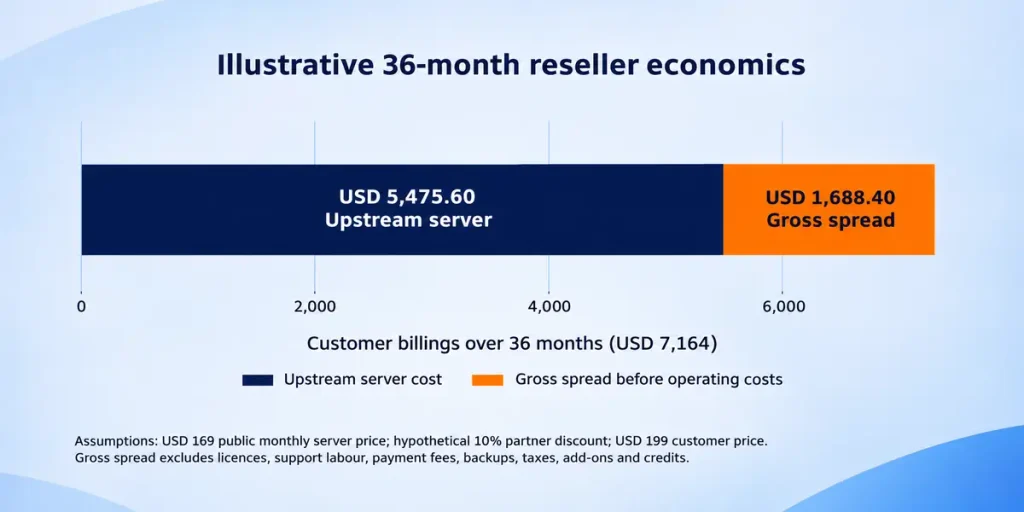
The 23.6% figure is a server-only spread ratio, not the reseller’s final gross margin. It subtracts only the upstream server charge. The actual gross margin is lower after licences, backups, additional IPs, bandwidth, payment fees, support labour, customer credits and other direct delivery costs.
For the 10% scenario, the net server cost is $152.10 per month and the server-only spread is $46.90 per month. Across 36 months, the spread is $1,688.40. The model assumes the $199 retail price and upstream price remain unchanged for all 36 months; it is not a forecast or a checkout quote.
Use this full-cost structure before signing: 36 × monthly recurring delivery costs + annual recurring charges due during the period + one-time setup, migration and exit costs + applicable taxes. Apply taxes only to the items and jurisdictions where they are legally chargeable. Calculate gross margin as (36-month customer revenue − 36-month direct delivery cost) ÷ 36-month customer revenue.
If a minimum-spend tier is based on the reseller’s total account bill rather than the individual server, model the whole account—not one customer in isolation. Keep one-time setup charges separate from recurring monthly costs.
Published reseller-program examples
The following are examples of published commercial structures, not a ranked shortlist. Public program pages do not expose equivalent partner quotes, so their percentages and minimums should not be compared as if they were the same wholesale offer.
| Provider | Published entry economics | Brand and integration | Important caveat |
|---|---|---|---|
| BudgetVM | Page lists 10% at $200/mo, 15% at $500, 20% at $2,500 and 25% at $5,000. | White-label portal, free SSL and IPMI/IPKVM access; tier benefits also list Windows VPS and cloud-backup allowances. | The same page’s worked example implies 3% at $200. A $169 server alone is below the $200 minimum. Confirm the tier and eligible spend in writing. |
| EqServers | At least $1,000/month in infrastructure and services; not a membership fee; partner prices are private. | 100% white-label positioning; WHMCS module included; US, Canada and European locations listed. | No public partner price list. Confirm partner-specific SLA applicability and credit pass-through. |
| Unihost | Entry threshold from $800/month; progressive discount from 10% up to 15% at larger volumes. | White-label resale; reseller sets end-customer prices; 20+ locations worldwide. | Reseller remains responsible for first-line support and AUP/abuse/spam complaints. |
| Server Room | $500 monthly minimum; server discounts from 5% to 20% and hosted-service discounts from 15% to 35%. | White-label account, invoices and tickets; API can manage existing servers; locations include US and European cities. | No enrollment fee or fixed-term contract is advertised, but the $500 monthly minimum is billed and unused balance expires. |
| ServerStadium | Published ladder ranges from 5% at $250/month to 40% at $10,000+. | WHMCS module; basic hardware/network troubleshooting; 24/7 hardware replacement is advertised. | Discount applies to base server cost only; existing services do not automatically move to a higher tier. Visible inventory includes EOL models. |
A separate contract check matters for EqServers. Its public Terms of Service says direct service orders are month-to-month unless a fixed term is specified, renew automatically, and must be cancelled at least 30 days before renewal. Fixed-term early termination charges equal the remaining recurring charges, and fees are non-refundable to the extent permitted by law. The same terms state that services are self-managed unless a written managed-services add-on applies: the customer is responsible for the operating system, applications, configuration, security hardening, patching, monitoring, backups and data restoration. A reseller must bind downstream users to terms no less protective than the TOS and AUP and remains liable for end-user acts and omissions. Confirm whether the partner agreement modifies any of these terms.
Server Room’s published program says there is no enrollment fee or fixed-term contract, but it also specifies a $500 monthly minimum. That minimum is billed monthly, pays the reseller’s own invoices for that month and any unused balance expires. Its API can reboot, reinstall, rename servers, set reverse DNS and read servers, invoices and tickets; it cannot place orders or make payments. Webhooks notify the reseller’s system when an invoice is paid or a server is ready.
Who handles support and abuse?
| Provider | Reseller responsibilities | Upstream support evidence | What to confirm |
|---|---|---|---|
| BudgetVM | Client support, billing/accounting, customer service, and prompt handling of abuse, DMCA and spam complaints. | Provider advertises 24/7 support; published SLA includes four-hour hardware replacement after diagnosis for regularly stocked servers. | Escalation route, reseller support hours, notice deadlines and downstream credit rights. |
| EqServers | Sales, billing, customer communication, first-line support, abuse and compliance matters. | Provider handles hardware, network, data-center and advanced infrastructure escalation. | Partner-specific response targets, coverage hours and whether end customers can claim upstream credits. |
| Unihost | First-line support and responsibility for AUP/abuse/spam complaints involving the reseller’s customers. | Partner page states 24/7 technical support. | Abuse Policy gives six hours after notification to resolve a complaint or submit a detailed response plan. |
| Server Room | Reseller supports its own customers; Server Room supports the reseller. | API manages existing servers and reads invoices/tickets; paid/ready webhooks are documented. | Confirm human escalation coverage and the exact API/webhook event catalogue. |
| ServerStadium | Reseller must incorporate the provider’s AUP into its own terms. | Basic hardware/network troubleshooting and 24/7 hardware replacement are advertised. | Exact first-line support split, abuse deadlines, termination rules and current hardware stock. |
BudgetVM expressly makes the reseller responsible for client support, billing/accounting, customer service and prompt handling of abuse, DMCA and spam complaints. Unihost’s Abuse Policy, last updated June 25, 2026, gives the customer six hours after notification to resolve an abuse complaint or provide a detailed response plan. Treat this as a contractual response window, not as a comfortable internal service target.
Read the SLA as a cash-flow and liability document
An SLA headline is useful only after you identify the measurement boundary, the event that starts the clock, exclusions, claim deadline, credit cap and remedy. A credit against a future upstream invoice is not cash compensation for the reseller’s customer, and it may not cover the reseller’s own service credits or lost revenue.
| Provider | Published commitment | Remedy and claim process | Material limitation |
|---|---|---|---|
| BudgetVM | 100% power and network availability; four-hour hardware replacement after staff diagnosis for regularly stocked dedicated servers. | 5% of monthly recurring fees for the first 15 minutes of cumulative downtime, then 5% per additional hour; missed hardware window gives five days of service credit. Credit request within five days. | If isolated downtime is reported more than one hour later, credit for time before the hour preceding the ticket is forfeited. Credits capped at 100%; DDoS, maintenance and customer-caused issues excluded. |
| EqServers | At least 99.9% monthly availability for power and the provider’s network edge, for covered self-managed services in controlled data centres. | 10% credit at 99.0–<99.9%; 30% at 95.0–<99.0%; 50% below 95%. Ticket during incident; claim within 30 days after month-end. | Clock starts only after a qualifying ticket and provider confirmation. Credits are future-invoice only and the sole remedy. Hardware swap target is 24 hours after fault confirmation, with no credit. |
| Unihost | 99.9% uptime; support response within four hours; critical failure resolution targeted within 12 hours and non-critical troubleshooting within 24 hours. | Published credits: 1%, 5%, 10%, 25%, or 60–100% according to downtime; maximum 100% of monthly payment. | Provider retains final decision; no compensation in the first month; credits are account balance only. The reviewed SLA page displays no clear revision date. |
BudgetVM’s SLA covers network and power, not every operating-system or application failure. It says a customer who takes more than one hour to report isolated downtime forfeits the credit for the period before one hour prior to ticket submission; this is more precise than saying that every outage must be reported within one hour. Hardware replacement is measured from BudgetVM staff diagnosis, and a credit request must be submitted within five days after the incident.
EqServers’ SLA is effective November 12, 2025. It applies to self-managed dedicated/bare-metal services provisioned in data centres operated or controlled by EqServers and covers only power and network availability at the provider’s border-router measurement boundary. The outage clock starts when the customer submits a qualifying support ticket and EqServers confirms the outage. Software, operating systems, customer configurations, backups, monitoring and managed services are outside this SLA unless a separate written addendum applies.
Unihost’s published SLA states 99.9% uptime, a maximum four-hour support response, critical-failure resolution within 12 hours and other troubleshooting within 24 hours. Its compensation table ranges from 1% to 60–100%, depending on uptime; the provider retains the final decision, credits are applied to the customer’s account balance, and no compensation applies during the first month. The page reviewed for this audit did not display a clear revision date, so confirm the operative version in the order or partner agreement.
Practical rule: write a separate customer-facing SLA that is no broader than the upstream commitments you can actually claim. Define what you monitor, how customers report incidents, who opens the upstream ticket, how quickly you notify customers, what credits you fund yourself and what happens when an upstream credit is denied. Ask the provider to confirm in writing whether its SLA rights can be passed through or assigned.
Licensing: the hidden cost and compliance layer
Do not assume that a server price includes every software licence required by the product you intend to sell. cPanel & WHM servers require a paid licence for each server running the software; CloudLinux is a separate licence. A 15-day trial is not a long-term licensing arrangement. Confirm whether the upstream provider includes a valid licence, whether it can be used for resale and what happens if the server is moved.
If you provide hosted Microsoft software services to end users, review the Microsoft Services Provider License Agreement (SPLA). Microsoft describes SPLA as a monthly licensing program under a three-year agreement. Its guidance requires monthly use or zero-use reporting, payment through a designated SPLA reseller, compliance with Service Provider Use Rights and technical support for Microsoft products delivered to end users. The exact licensing model depends on the hosted product and deployment.
A WHMCS provisioning module is not, by itself, evidence that your WHMCS platform subscription is included. Ask for a written schedule of every software component, its billable unit, renewal cycle, licence owner, permitted customer use and migration/transfer rule.
Abuse, DMCA and Canadian notice-and-notice duties
Your upstream provider can suspend a server or account when a customer sends spam, hosts malware, launches attacks, infringes intellectual property or creates a security risk. The reseller therefore needs an abuse mailbox, a monitored escalation channel, customer identification records, timestamps, a repeat-offender process and a documented suspension path.
For US hosting services, Section 512 of the DMCA provides conditional safe harbors. The applicable duties depend on the service-provider category. For hosting or storage at users’ direction, qualifying providers generally need to designate and register a DMCA agent, publish the agent’s contact details, respond expeditiously to substantially compliant notices and adopt and reasonably implement a repeat-infringer policy. The safe harbor is conditional; it is not a blanket immunity and does not create a general duty to monitor all user content.
Canada’s Copyright Act has a distinct Notice-and-Notice regime. Under section 41.26, covered intermediaries receiving a compliant notice must forward it as soon as feasible and retain records that can identify the relevant subscriber for six months. If proceedings are commenced and notice is given within that six-month period, the retention period extends to one year after receipt of the notice. This is not the same as an automatic US-style takedown process. Whether a particular reseller is a covered intermediary depends on its role and the applicable law; obtain legal advice for the business model and jurisdictions involved.
This section is a general compliance overview, not legal advice. Before launch, have counsel assess the reseller’s role, service architecture, customer terms, notice workflow, data-retention policy and countries served.
The pre-signature checklist
- Wholesale price: obtain a written price for each CPU/RAM/storage/network configuration and all mandatory add-ons.
- Minimum commitment: confirm the threshold, eligible spend, whether tiers use gross list spend or net invoices, reset date and shortfall consequences.
- Term and renewal: check month-to-month versus fixed term, auto-renewal, notice period, early termination charges, deposits and prepayment.
- Price changes: ask how hardware, bandwidth, IP, software and currency changes affect renewals and existing customer contracts.
- White-label scope: confirm branding on portal, invoices, emails, DNS, reverse DNS, support tickets, IP records and customer access.
- Provisioning: verify API/WHMCS functions for order, suspend, unsuspend, reinstall, upgrade, terminate, status sync and billing events.
- Licensing: identify who owns Windows, cPanel, Plesk, CloudLinux and other licences; confirm resale rights, reporting and transferability.
- Support split: define first-line, hardware, network, OS, security, backup and application support. Obtain response and resolution targets separately.
- Abuse workflow: set monitored contacts, response windows, evidence requirements, suspension authority, customer notice and record retention.
- SLA mechanics: check measurement boundary, start/stop events, exclusions, claim deadlines, credit cap, sole-remedy wording and pass-through rights.
- Exit plan: confirm data export, IP portability, migration assistance, backup retrieval, cancellation timing and customer transition obligations.
Which program fits which reseller?
BudgetVM is worth a quote when US locations and a branded portal matter. Its public pages expose server configurations, a reseller discount ladder and an SLA. However, the discount page is internally inconsistent about the discount applicable at $200 monthly spend, and a single $169 server does not meet the stated $200 minimum. Obtain a written tier calculation before modelling the economics.
EqServers is worth evaluating when a North American or European footprint and a defined WHMCS workflow matter. Its partner page lists a $1,000 monthly infrastructure minimum, an included WHMCS module and a clear split between reseller first-line duties and provider infrastructure escalation. Partner pricing is private, and the standard SLA is narrower than a full managed-service commitment.
Unihost is worth considering when the reseller can meet an $800 monthly threshold and wants 24/7 upstream technical support. Its current partner page states a progressive discount from 10% to 15%, but the reseller still owns first-line support and abuse obligations. Confirm the SLA version and the current six-hour abuse-response rule before promising downstream service levels.
Server Room is worth considering when a reseller wants a $500 monthly minimum, tiered server/hosted discounts, white-label invoices and a mix of US and European locations. The unused monthly minimum expires. Its API cannot place orders or make payments, but documented webhooks signal paid invoices and ready servers. Confirm the SLA, event catalogue and human escalation path.
ServerStadium’s published discount ladder may suit resellers with several servers and growing monthly spend. The discount applies to base server cost only, and existing services do not automatically move to a higher tier. The public inventory includes end-of-life configurations, so obtain a current SKU and stock confirmation before quoting customers.
There is no defensible overall winner from the public evidence alone. The partner prices are not fully comparable, the discount structures use different thresholds and bases, and the SLAs measure different things. Choose a provider only after comparing a written 36-month quote and the exact partner agreement against your support and compliance capacity.
Next step
Compare the full 36-month cost and contractual obligations before choosing. Start with HostChoices’ web hosting decision guide, review what web hosting is and how server types differ, and use the web hosting cost calculator to keep long-term costs visible.
No affiliate links are included in this article. Provider prices and program terms can change; verify the current quote, agreement and final checkout before making a commercial commitment.
Sources and further reading
- BudgetVM reseller program — official provider page; checked 2026-11-07.
- BudgetVM dedicated server listing — official provider page; checked 2026-11-07.
- BudgetVM SLA — official provider SLA; checked 2026-11-07.
- EqServers partner and reseller program — official provider page; checked 2026-11-07.
- EqServers SLA — official provider SLA; checked 2026-11-07.
- EqServers Terms of Service — official provider terms; checked 2026-11-07.
- Unihost partner program — official provider page; checked 2026-11-07.
- Unihost Abuse Policy — official provider policy; checked 2026-11-07.
- Unihost SLA — official provider SLA; checked 2026-11-07.
- Server Room reseller program — official provider page; checked 2026-11-07.
- ServerStadium reseller program — official provider page; checked 2026-11-07.
- cPanel licence documentation — official software documentation; checked 2026-11-07.
- Microsoft SPLA guidance — official software licensing guidance; checked 2026-11-07.
- U.S. Copyright Office Section 512 resources — official government guidance; checked 2026-11-07.
- Canada Copyright Act section 41.26 — official legislation; checked 2026-11-07.