

GoDaddy alternatives 2026: 8 better hosting options for every budget
Disclosure: HostChoices may earn a commission when you buy through links on this page, at no extra cost to you. You won’t be charged any additional fees if you make a purchase.
Introduction
If you are comparing GoDaddy alternatives, focus on the total cost after the first term, not just the lowest advertised price. We checked current plans and renewal rates on July 16, 2026, using GoDaddy Economy at $5.99 per month and $11.99 on renewal as the baseline. SiteGround is our top pick for managed WordPress support, while Hostinger offers the best long-term prepaid value. You can check SiteGround’s current plans.
Best GoDaddy alternatives right now: quick picks table
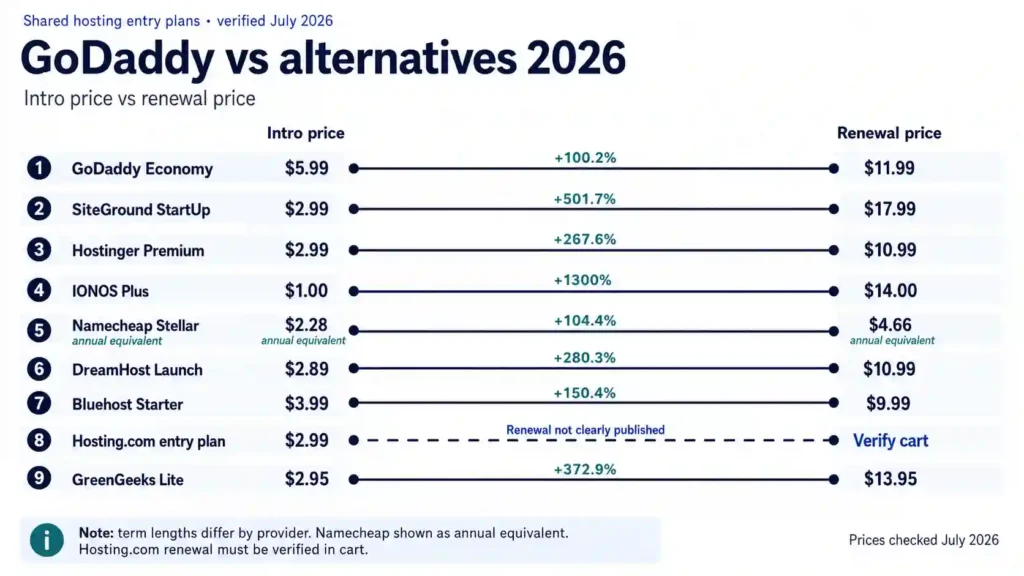
The table uses the lowest practical entry plan we could verify on current US-facing pricing pages. A low monthly figure may require paying 12, 36, or 48 months upfront, so the term column matters as much as the headline price.
Provider | Discount | Intro price | Renewal price | Initial term | Best for | Deal link |
SiteGround StartUp | 83% | $2.99/mo | $17.99/mo | 12 months | Managed WordPress support | |
Hostinger Premium | 75% | $2.99/mo | $10.99/mo | 48 months | Lowest long-term prepaid cost | |
IONOS Plus | 94% | $1.00/mo | $14.00/mo | 12 months | Lowest first-year bill | |
Namecheap Stellar | About 61% | $27.48/year ($2.29/mo eq.) | $55.88/year ($4.66/mo eq.) | 12 months | Low annual renewal and cPanel | |
DreamHost Launch | 75% | $2.89/mo | $10.99/mo | 12 months | Daily backups and 25 sites | |
Bluehost Starter | About 60% | $3.99/mo | $9.99/mo | 36 months | WordPress-first setup | |
Hosting.com entry plan | Up to 75% | $2.99/mo | Varies by plan; verify cart | Term varies | cPanel and free migration | |
GreenGeeks Lite | 79% | $2.95/mo | $13.95/mo | 12 months | Eco-focused shared hosting |
My pricing read: IONOS is the cheapest for year one, Namecheap has the gentlest US-dollar renewal, Hostinger has the strongest four-year prepaid value, and SiteGround charges the largest premium after renewal in exchange for a more managed support layer.
How we verify these deals are real
We do not copy the first price shown in a search snippet and call it finished. For this update, we opened each provider’s official pricing page, recorded the plan name, billing term, amount charged over the initial term, published renewal rate, website limit, storage, backup policy, migration offer, and refund window.
We then cross-checked renewal pricing against official help-center tables where available. Namecheap is a good example: its support notice says new Shared Hosting renewal prices took effect on May 19, 2026, with Stellar renewing at $55.88 for one year. Bluehost also publishes a separate renewal table, which is more useful than a large discount badge.
Our refresh cadence is weekly for prices and monthly for plan features. We also recheck after major sale periods and whenever a provider changes checkout language. A deal is marked as uncertain when a provider displays a starting price but does not expose the exact renewal total for that plan in readable page text.
Performance claims need a different standard. This article does not invent a speed score or support transcript. We use current plan facts here and point readers to full HostChoices reviews for sustained uptime, load tests, and support records. Google’s Core Web Vitals guidance explains that user experience should be assessed through loading performance, responsiveness, and visual stability rather than a single marketing speed claim. W3Techs updates its hosting market-share reports regularly, but market share is context, not proof that one host is faster.
Why that matters: a $2.99 plan billed for 48 months is a $143.52 purchase, while a $2.99 plan billed for 12 months is a $35.88 purchase. The same monthly label can describe two very different commitments.
Deal breakdown by provider
SiteGround: best managed alternative for small business WordPress
SiteGround StartUp is $2.99 per month for the first 12 months and renews at $17.99 per month. It supports one site and includes SSL, daily backups, a CDN, managed WordPress tools, and a 30-day money-back guarantee. The first-year hosting charge is $35.88 before tax; the next 12-month renewal is $215.88.
The price jump is steep, but the product is easier to run than a bare-bones budget account. I prefer it for a revenue-producing brochure site, professional blog, or small WooCommerce project where support quality and restore tools matter more than the lowest renewal. The current GoDaddy alternatives discount 2026 is already built into SiteGround’s page rather than requiring a code.
see SiteGround pricing in detail, then inspect the term and renewal line before payment.
Hostinger: best long prepaid value
Hostinger Premium is $2.99 per month when paid for 48 months, for a total of $143.52. It renews at $10.99 per month. The current plan allows three websites, includes a domain for the first year, weekly backups, CDN access, email for the promotional period, and WordPress tools.
That four-year commitment is the catch. For a site you expect to keep, it gives you a lower effective cost than GoDaddy Economy and delays the renewal event for four years. For a short experiment, paying $143.52 upfront may be less attractive than a one-year plan elsewhere.
IONOS: cheapest first-year bill
IONOS Plus is $1.00 per month for a one-year term, then $14.00 per month. That means $12 before tax for the first year and $168 for the next year. The plan lists unlimited websites, storage, and databases, plus daily backup, a domain, SSL, email, SSH, SFTP, and WP-CLI.
This is the cleanest answer when cash today is the only hard limit. It is not the cheapest host to keep automatically. Set a renewal reminder when the account is opened and compare the lower-tier Essential plan, which currently starts at $4.00 and renews at $8.00 for one site.
Namecheap: lowest predictable US-dollar annual renewal
Namecheap Stellar is the value pick for users who want cPanel and annual billing. The current first-year equivalent is about $2.28 to $2.29 per month, while the official renewal notice sets the one-year Stellar renewal at $55.88, or about $4.66 per month.
Namecheap raised Shared Hosting renewal prices on May 19, 2026, but the resulting annual rate remains below every other US-dollar renewal in this comparison. A godaddy alternatives promo code 2026 is usually unnecessary because the public new-customer price is applied directly. Check that the cart still matches the advertised annual total.
DreamHost: best for backups and a generous site allowance
DreamHost Launch is $2.89 per month for the first year and auto-renews at $10.99 per month. The plan lists 25 websites, 25 GB of NVMe storage, daily automated backups, unlimited SSL certificates, a free domain for one year, and a 30-day money-back guarantee.
The 25-site allowance is unusually generous for an entry plan. It fits a freelancer with several modest WordPress sites better than a one-site plan. DreamHost charges the full term plus tax at checkout, so the first-year base hosting total is $34.68.
Bluehost: best familiar WordPress onboarding
Bluehost Starter is $3.99 per month on the 36-month option and renews at $9.99 per month on a 36-month renewal. The plan includes one website, a free first-year domain, SSL, weekly backups, malware scanning, a migration tool, and a published 99.99% uptime SLA.
Bluehost is not the lowest intro price, but it has a clearer WordPress-oriented setup than many generic cPanel accounts. WordPress.org’s official hosting page continues to list Bluehost among its recommended hosts. Before choosing any provider, also compare the server stack with WordPress.org’s current technical requirements. The trade-off is a three-year upfront commitment to secure the lowest displayed rate.
Hosting.com: best cPanel migration option
Hosting.com currently advertises shared hosting from $2.99 per month and savings up to 75%. Its entry hosting includes NVMe storage, LiteSpeed caching, SSL, malware protection, weekly backups, cPanel email, a 99.9% uptime SLA, and free website migration.
The renewal total must be checked at cart level for the exact plan and term. That lack of a single clean entry-plan renewal number is why Hosting.com ranks below providers with fully visible renewal tables. It remains a sensible option for users leaving GoDaddy who want cPanel and hands-on migration help.
GreenGeeks: best eco-focused shared host
GreenGeeks Lite costs $2.95 per month prepaid for 12 months and renews at $13.95 per month. It supports one website with 25 GB of space, unmetered traffic, SSL, cPanel, and a 30-day money-back guarantee.
The first-year total is $35.40, while the next annual term is $167.40. GreenGeeks is not the renewal winner, but it is a practical fit for a small site that values cPanel and the provider’s environmental positioning. Its public page states the renewal rate beside the intro rate, which is the right way to present a hosting offer.
Renewal-price traps to watch for
The largest percentage jump in this comparison is IONOS Plus: $1.00 to $14.00, a 1,300% increase. SiteGround StartUp rises from $2.99 to $17.99, about 501.7%. GreenGeeks Lite rises from $2.95 to $13.95, about 372.9%. Those percentages look dramatic because the intro prices are deeply discounted.
Absolute annual cost is more useful. SiteGround adds $180 per year after the first term. IONOS adds $156. GreenGeeks adds $132. Hostinger adds about $96 per year after its four-year term, while Namecheap’s published annual renewal adds about $28.40 versus a $27.48 first-year equivalent.
Watch the billing cycle, not just the renewal rate. Bluehost’s $9.99 renewal is tied to a 36-month term, while DreamHost’s $10.99 figure is shown for a one-year renewal. A lower monthly renewal can still require a much larger upfront payment.
Domains and email can move separately from hosting. ICANN’s registrant transfer guidance explains that domain holders can transfer between accredited registrars, but a new registration, a recent transfer, or certain registrant-information changes may trigger a 60-day restriction. Keep domain control, hosting access, backups, and email credentials separate before you cancel GoDaddy.
W3Techs’ web-hosting usage report places GoDaddy Group among the larger hosting providers, but scale does not make its plan the best fit for every site. Use market share as a stability signal, then judge the actual plan on renewal cost, resource limits, restore options, and support access.
Other ways to save
Seasonal sales can lower the first term, but they rarely change the standard renewal. The cheapest hosting deal 2026 is only a real saving when the billing term matches how long you expect to keep the site.
First, separate your domain from your hosting decision. A free first-year domain can save roughly one registration fee, but it should not trap you in a weak hosting plan. Confirm the second-year domain renewal and privacy charge.
Second, choose the shortest term that still gives a reasonable price when the project is uncertain. IONOS and DreamHost let you test a one-year economics model without paying four years upfront. Hostinger makes more sense after the site concept is proven.
Third, remove optional add-ons before checkout. Paid security packs, premium email, SEO tools, and backup upgrades can erase the headline discount. The base plan should already include SSL and a workable backup path. MDN’s web-security guidance recommends serving all pages and subresources over HTTPS, so SSL should be treated as a baseline requirement rather than a premium extra.
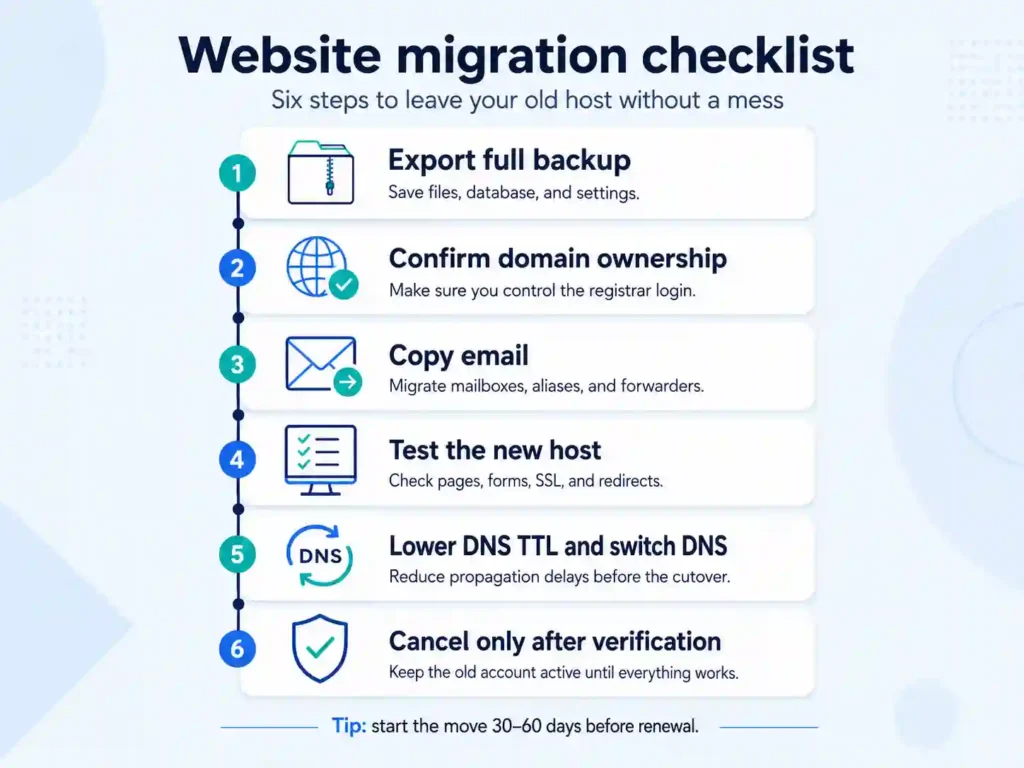
Fourth, migrate before the renewal invoice is generated. Start 30 to 60 days early, lower DNS time-to-live, create a full backup, copy email, test the new site through a temporary URL or hosts-file entry, and only then change DNS. CISA’s website-security guidance recommends automated, continuous backups of critical website data and configurations; verify that your backup can actually be restored before the cutover.
Finally, ask support whether they will migrate the site and email. A free migration can be worth more than a small coupon when the alternative is several hours of technical work.
Who should grab which deal
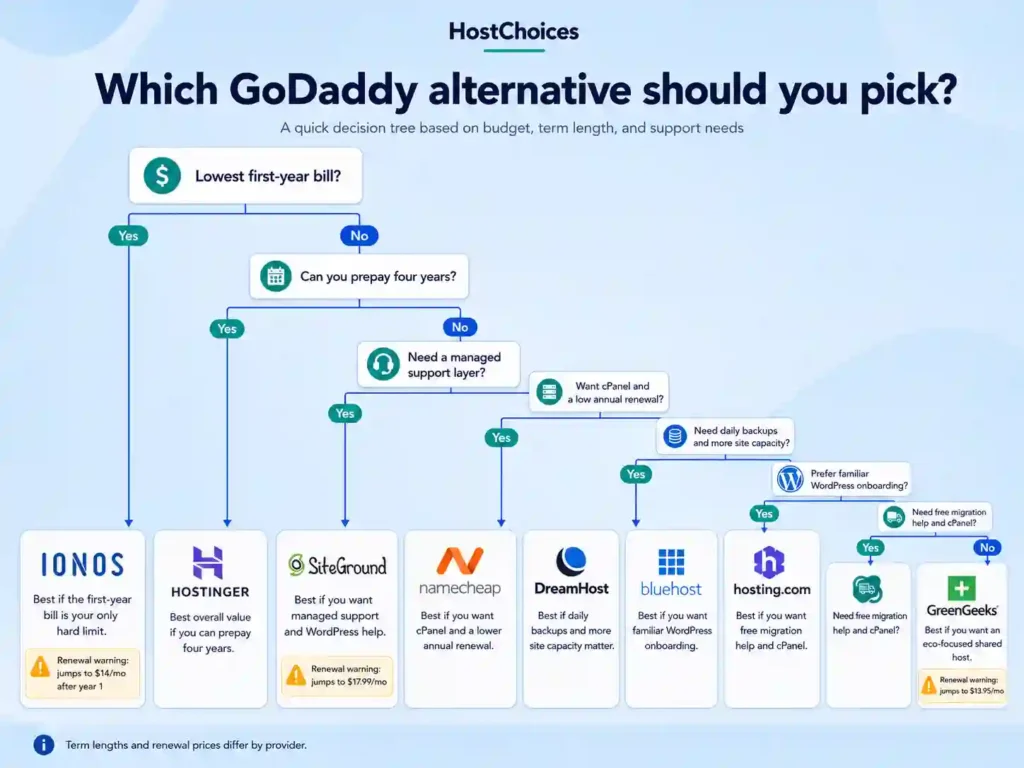
Choose SiteGround when the website earns money, you want managed WordPress tools, and paying more at renewal is acceptable. Read our top GoDaddy alternative for the full HostChoices test and support notes. (URL TO CONFIRM)
Choose Hostinger when you can prepay four years and want the strongest long-term promotional value. It is the most rational choice for a blog, portfolio, or small business site that is likely to stay online.
Choose IONOS when the first-year bill must be as close to zero as possible. Do not leave auto-renewal unplanned. For a single site, compare Essential at $4.00 intro and $8.00 renewal with Plus at $1.00 intro and $14.00 renewal.
Choose Namecheap when you want cPanel, annual billing, and the lowest published US-dollar annual renewal in this group. It is also easier to budget than a host that requires three or four years upfront.
Choose DreamHost when daily backups and capacity for up to 25 sites matter. Choose Bluehost when you want a familiar WordPress onboarding path and are comfortable paying a 36-month term.
Choose Hosting.com when free migration and cPanel are the priority, but verify the renewal total in the cart. Choose GreenGeeks when the eco-focused positioning matters and the $13.95 renewal fits your budget.
For a broader comparison, HostChoices covers godaddy alternatives across hosting types. When you are ready to move, follow how to migrate away from GoDaddy before cancelling the old account. (Article URL TO CONFIRM)
A simple decision rule
Set a two-year or four-year ceiling before opening any cart. If the project is temporary, optimize for the total first-year bill and an easy exit. If the site will stay online, add the initial term and one renewal term. If support failures could cost revenue, treat managed help and daily restore points as part of the price rather than optional extras.
The verdict — best overall GoDaddy alternative right now
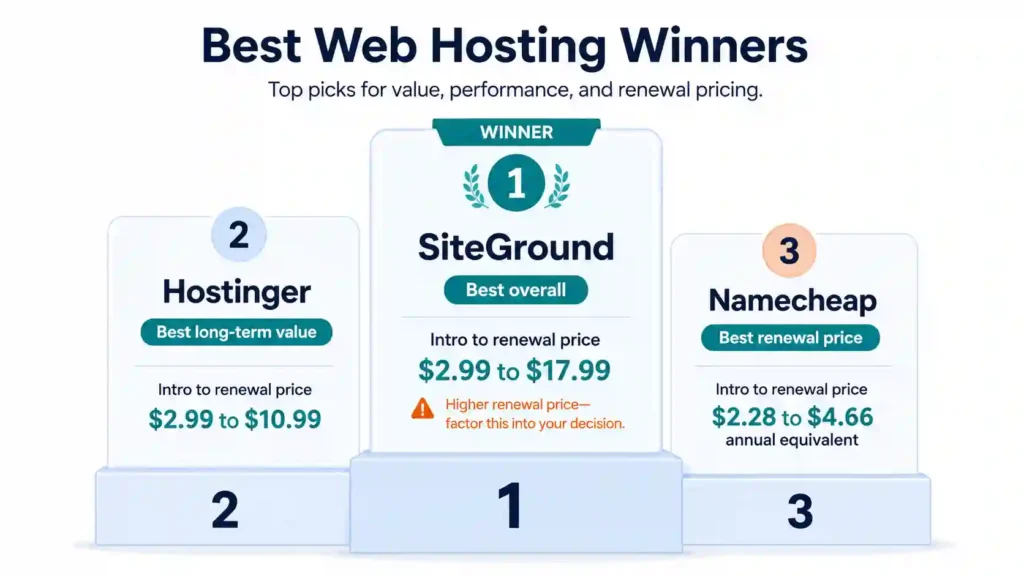
SiteGround is the best overall choice among these GoDaddy alternatives for a small business or serious WordPress site because it combines clear onboarding, daily backups, managed WordPress tools, migration help, and a support layer that is easier for nontechnical owners to use. The weakness is obvious: StartUp renews at $17.99 per month, well above GoDaddy Economy’s commonly published $11.99 renewal. It wins on the managed experience, not on long-run price.
Hostinger is the value winner. Paying $143.52 for 48 months is hard to beat when you know the site will last. Namecheap is the renewal winner, while IONOS is the first-year price winner.
For the balanced business pick, get SiteGround at the best price and verify the 12-month term and $17.99 renewal before checkout. claim your SiteGround discount only after comparing the renewal against your four-year budget.
Frequently asked questions
What is the best GoDaddy alternative in 2026?
SiteGround is the best overall GoDaddy alternative for small business WordPress users who value managed tools and support. Hostinger is better when long-term price matters more than the managed support layer.
What is the cheapest alternative to GoDaddy?
IONOS Plus has the lowest first-year bill at $1.00 per month for 12 months. It renews at $14.00 per month, so Namecheap or Hostinger may cost less over a longer period.
Which GoDaddy alternative has the lowest renewal price?
Namecheap Stellar has the lowest published US-dollar annual renewal in this comparison at $55.88 per year, about $4.66 per month. The figure is an annual equivalent, not a month-to-month rate.
Can I move my WordPress site away from GoDaddy without downtime?
Yes, you can usually move a WordPress site without visible downtime by copying the site first, testing it, and changing DNS only after the new copy works. Start 30 to 60 days before renewal and keep the old account active during propagation.
Should I keep my domain at GoDaddy after moving hosting?
Yes, you can keep the domain at GoDaddy while moving only the hosting, because domain registration and web hosting are separate services. Transfer the domain later only when ownership details, transfer locks, and email are fully under control.