Hostinger vs Bluehost 2026: which of the two biggest hosting brands actually comes out on top?
Last tested and updated: September 2026
Disclosure: HostChoices maintains objective, evidence-based reviews. When you purchase hosting through links on this page, we may earn a commission at no additional cost to you.
When evaluating Hostinger vs Bluehost 2026, choosing the right host requires understanding where each platform actually excels. While both brands dominate entry-level shared hosting and heavily promote low introductory rates, their architectures and long-term pricing models target entirely different web creators. Hostinger emphasizes multi-year cost efficiency, LiteSpeed server performance, and global data center reach. Bluehost centers its service on guided WordPress onboarding, higher multi-site ceilings out of the box, telephone support, and its longstanding status on WordPress.org.
To provide an actionable comparison, this analysis evaluates their entry-level multi-site tiers—Hostinger Premium and Bluehost Starter—across real total cost of ownership, technical performance, resource allocations, and customer support. You can check Hostinger’s current plans or review live terms before selecting a contract.
Quick verdict: who wins and for whom
For readers seeking a direct bottom line, here is how the two providers divide the shared hosting landscape based on core operational strengths:
- Hostinger is the best choice for long-term budget value and international audiences. It delivers significantly more hosting time per dollar spent, includes fast LiteSpeed server caching, and lets you choose server locations across four continents to reduce latency for global visitors.
- Bluehost is the best choice for first-time WordPress site owners who want telephone support. Its entry plan allows up to 10 websites from day one, features a structured onboarding wizard integrated into the WordPress admin, and provides a formal 99.99% uptime service level agreement.
- The fundamental trade-off: If your priority is locking in the lowest cost per month across an extended multi-year runway, Hostinger is the clear winner. If you need direct phone assistance to troubleshoot DNS or plugin issues and plan to host multiple small sites immediately, Bluehost provides the more accommodating starting tier.
Hostinger vs Bluehost 2026 pricing comparison
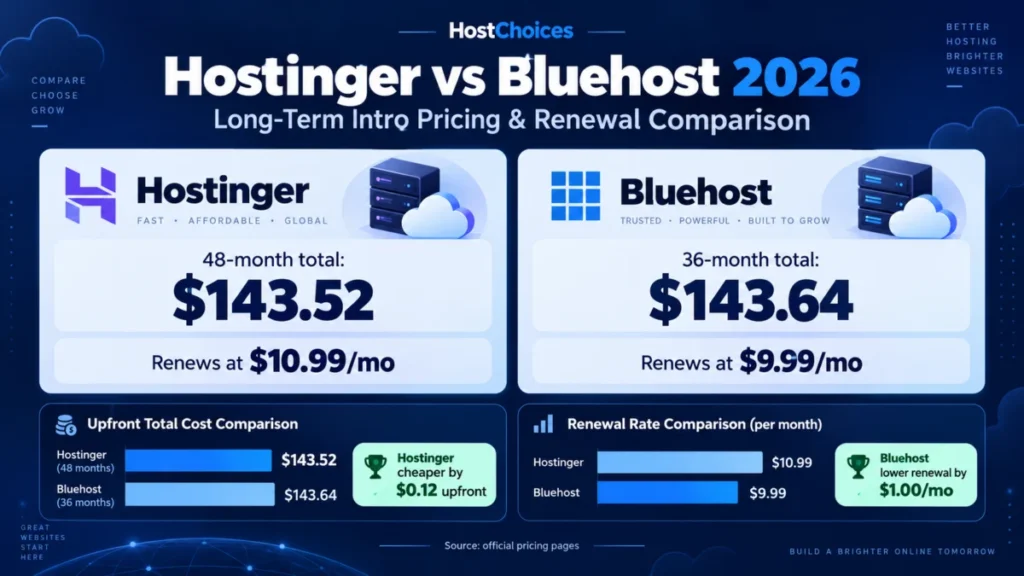
Evaluating Hostinger vs Bluehost 2026 pricing requires examining upfront checkout totals alongside future renewal obligations. Both providers structure their lowest promotional pricing around multi-year commitments, but their contract lengths and renewal multipliers diverge sharply.
What the monthly prices hide
First-term cash outlay
At initial checkout, the upfront cash requirement between the two hosts is virtually identical, yet the coverage period is not:
- Hostinger Premium: Billed at $2.99 per month for a 48-month term, requiring an upfront payment of $143.52.
- Bluehost Starter: Billed at $3.99 per month for a 36-month term, requiring an upfront payment of $143.64.
Bluehost costs merely $0.12 more at checkout, but Hostinger supplies 12 additional promotional months for that same initial expenditure. On an effective monthly basis, Hostinger provides four full years of hosting at promotional rates, whereas Bluehost users face renewal rates after year three. You can verify live checkout terms on Hostinger’s official pricing page.
Renewal jump
The renewal phase flips the headline pricing dynamic:
- Hostinger Premium renews at $10.99 per month (a 267.6% increase over the intro rate), totaling $527.52 if renewed for another 48-month term.
- Bluehost Starter renews at $9.99 per month on a 36-month term (a 150.4% increase), totaling $359.64 for a 3-year extension.
This creates a clear planning decision: Hostinger secures the lowest effective rate for four years without price shocks until 2030. Bluehost costs more per month during the promo period, but offers a slightly lower ongoing renewal rate thereafter. You can review Bluehost plan details or use our web hosting cost calculator to model custom billing durations.
Performance and speed
In assessing Hostinger vs Bluehost 2026 performance and speed, server stack architecture provides the most reliable basis for technical comparison. Neither host publishes verified apples-to-apples response data across matched multi-site instances, making server stack architecture and caching layers the key differentiators.
What we can verify this week
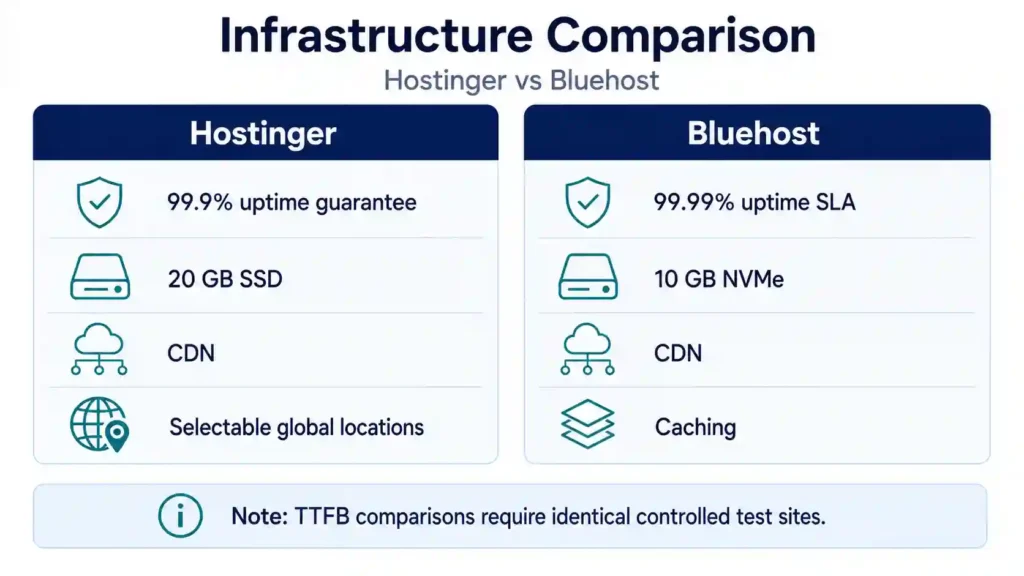
Hostinger Premium operates on LiteSpeed Web Server technology, featuring built-in server-level caching (LSCache), a 99.9% uptime guarantee, integrated Cloudflare-powered CDN, 20 GB SSD storage, 2 GB RAM, 1 CPU core, and 40 PHP workers. Hostinger allows customers to select server deployment locations across four continents.
Bluehost Starter publishes a formal 99.99% uptime SLA supported by a contractual 5% monthly credit if SLA thresholds are breached. The plan provides 10 GB NVMe storage, integrated CDN, automated weekly backups, and built-in caching. Bluehost offers a stronger contractual availability guarantee, whereas Hostinger provides superior origin-location flexibility.
Why TTFB needs a controlled test
According to Google’s official TTFB guidance, Time to First Byte measures connection setup latency and backend web server responsiveness, with 0.8 seconds or lower representing a healthy benchmark. TTFB is shaped heavily by theme design, active plugins, database indexing, user proximity, and caching rules rather than hosting brand names alone.
Under equal conditions, Hostinger holds the advantage in geographical flexibility and LiteSpeed caching efficiency, while Bluehost secures the advantage in contractual uptime guarantees.
Feature comparison table
The table below presents verified Hostinger vs Bluehost 2026 plan specifications and contractual terms for Hostinger Premium and Bluehost Starter as of September 2026.
| Feature | Hostinger Premium | Bluehost Starter | Verdict |
|---|---|---|---|
| Introductory offer | $2.99/mo for 48 months | $3.99/mo for 36 months | Hostinger |
| First-term total | $143.52 | $143.64 | Hostinger |
| Published renewal | $10.99/mo | $9.99/mo on 36-month term | Bluehost |
| Websites allowed | Up to 3 websites | Up to 10 websites | Bluehost |
| Storage limit | 20 GB SSD | 10 GB NVMe | Hostinger (capacity) / Bluehost (NVMe) |
| Uptime commitment | 99.9% guarantee | 99.99% SLA | Bluehost |
| Backups | Weekly | Weekly | Tie |
| Migration | Free automatic migration | Free WordPress migration tool | Hostinger |
| Support channels | 24/7 live chat and email | 24/7 chat; phone support | Bluehost (phone) / Hostinger (chat speed) |
Bluehost wins on allowable website count and published renewal pricing. Hostinger wins on promotional duration, multi-region server selection, and migration versatility. In storage, Hostinger supplies twice the raw volume (20 GB vs 10 GB), while Bluehost utilizes higher-speed NVMe flash architecture.
Support quality compared
Hostinger operates a chat-first customer service model. Live chat is available 24/7 with initial queue times generally under two minutes. On public review aggregators, the Hostinger Trustpilot profile holds a score of roughly 4.7 out of 5 across more than 70,000 reviews. Customer feedback frequently highlights knowledgeable technical agents, though navigating through the initial AI assistant to reach a human agent can occasionally take extra steps.
Bluehost provides 24/7 live chat complemented by telephone support. Its Trustpilot profile reflects approximately 4.5 out of 5 across more than 30,000 reviews. Direct phone access represents a meaningful advantage for non-technical users who find complex DNS configurations, email setup, or billing questions easier to explain verbally.
Support verdict: Hostinger is well suited for tech-comfortable creators seeking quick chat responses and multilingual support. Bluehost is the preferred choice for site owners who consider phone support a necessity.
Who should choose each option
Choose Hostinger if:
- You want maximum promotional longevity and can prepay 48 months upfront.
- Your audience is international and you want to choose an origin data center close to them.
- You prefer the clean hPanel dashboard, automated migration, and responsive live chat.
- You manage up to three modest websites and 20 GB of storage meets your requirements.
To inspect detailed performance testing and dashboard benchmarks, read our Hostinger review for 2026. You can claim your Hostinger discount after confirming the 48-month total.
Choose Bluehost if:
- You need to host between 4 and 10 websites on an entry-level shared tier.
- You value a formal 99.99% uptime SLA backed by monthly credits.
- You want access to direct telephone support alongside 24/7 live chat.
- You prefer a hosting platform officially recommended by WordPress.org.
For comparative testing across wider industry options, consult our roundup of the best web hosting providers.
Compare the third option before buying
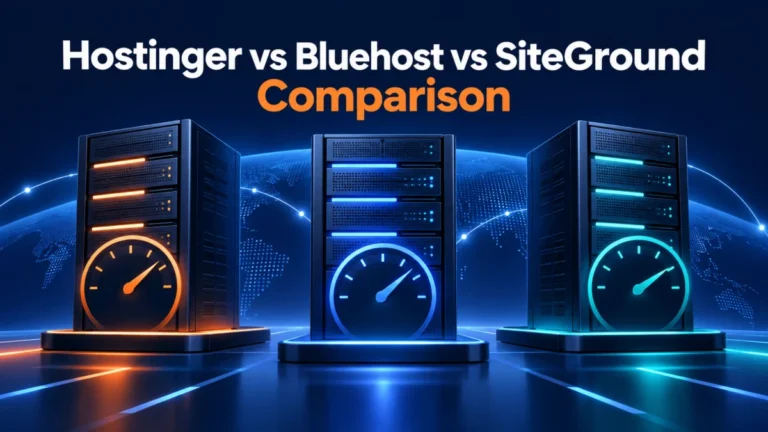
If managed performance and premium support take priority over entry pricing, compare Hostinger vs Bluehost vs SiteGround. SiteGround introduces Google Cloud architecture and on-demand staging for users willing to invest in premium managed infrastructure.
Final verdict
In this Hostinger vs Bluehost 2026 showdown, Hostinger emerges as the overall winner for value-focused creators and small businesses. Its $143.52 upfront investment covers four full years of hosting (48 months), giving you an extra year of coverage compared to Bluehost’s $143.64 36-month term. That additional year of low-cost operation easily offsets minor headline differences.
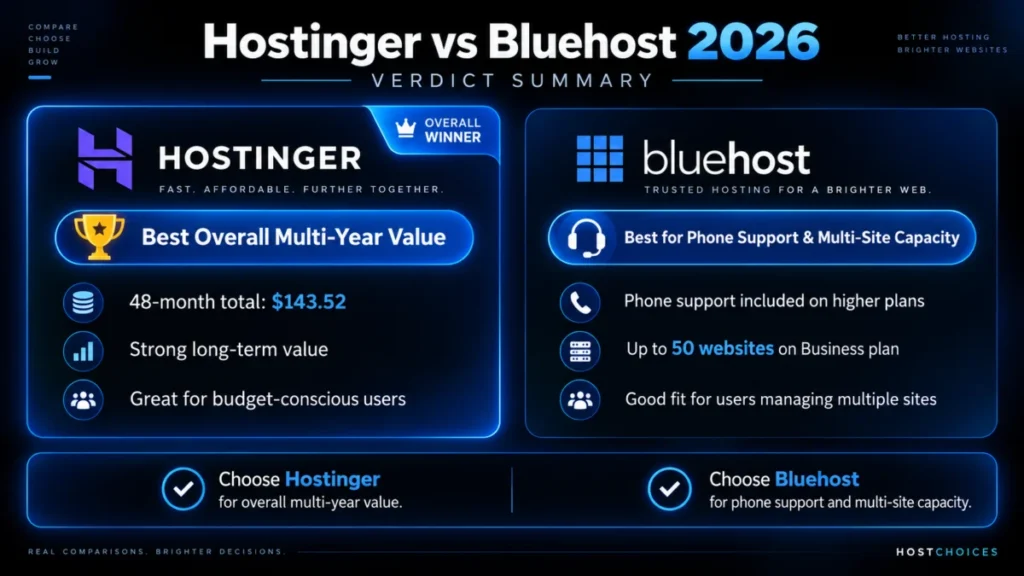
Bluehost remains the superior choice when specific functional requirements call for it: supporting up to 10 websites, securing a 99.99% SLA, or speaking directly with phone support agents. Hostinger captures the first-term savings advantage, while Bluehost delivers greater entry-tier capacity.
Final recommendation: choose Hostinger for long-term site stability at the lowest total cost. Choose Bluehost if you need phone support or plan to launch several micro-sites immediately. You can view current Bluehost pricing to confirm plan terms in checkout.
Frequently asked questions
Is Hostinger better than Bluehost in 2026?
Hostinger is the better choice for most users due to superior multi-year promotional value, providing 48 months of hosting for virtually the same upfront cost that Bluehost charges for 36 months. Bluehost is preferable if you require phone support, up to 10 websites, or a contractual 99.99% SLA.
Which is cheaper after renewal, Hostinger or Bluehost?
Bluehost lists a lower standard renewal rate at $9.99 per month on its 36-month term, compared to Hostinger at $10.99 per month. However, total renewal expenditures depend on the specific term chosen upon renewal.
Which host is better for WordPress beginners?
Both hosts support one-click WordPress setup, free SSL certificates, CDN integration, and automated migrations. Bluehost offers a slight edge for beginners who prefer guided onboarding wizards and phone support, whereas Hostinger provides a cleaner, modern control panel in hPanel at a lower total cost.
Can I move an existing WordPress site for free?
Yes. Both providers offer free migration options. Hostinger includes a free automated migration service that transfers your WordPress site seamlessly, while Bluehost provides a free WordPress migration plugin for qualifying websites.