

Web hosting cost calculator (2026): Compare the true cost from 1 to 4 years
Most hosting pages lead with one attractive monthly number. That number can be useful, but it rarely tells you how much cash you will actually need or what the same plan costs over the period you expect to keep it. A 48-month promotion, for example, can make a three-year comparison look odd because you may have to pay for four years upfront.
This free web hosting cost calculator is built for that problem. Choose a 1-, 2-, 3- or 4-year horizon, enter the exact introductory term and renewal cycle, then add the domain and extras that apply to you. The tool shows both the cash you may need to fund and a period-equivalent cost that keeps comparisons on the same time horizon.
| Quick rule: compare the period-equivalent cost when you are deciding which plan is cheaper over the same number of months. Then check cash required and prepaid overhang before you decide whether the commitment fits your budget. |
Web Hosting Cost Calculator: Compare 1- to 4-Year Costs
Enter the exact plan terms you see at checkout. The calculator separates what you may need to pay in full billing blocks from the cost attributable to the 1-, 2-, 3- or 4-year period you want to compare.
Your 4-year summary
| Horizon | Cash required | Period-equivalent cost | Billing-block overhang |
|---|
| Component | Modeled cost | Share |
|---|
Planning model only, not a live quote. The cash-required view assumes each billing block you enter is paid in full when due. The period-equivalent view prorates hosting across the selected 1- to 4-year horizon. Taxes, credits, refunds, regional fees, payment timing, add-on billing periods and future price changes can differ. Verify the final checkout and renewal terms before purchase.
Privacy: calculations run in your browser. This tool does not ask for personal information or send the values you enter to HostChoices.
Why a 4-year hosting cost view matters
Long-term hosting discounts do not all use the same contract length. Some plans are sold for 12 or 36 months, while others use a 48-month introductory term. If a calculator stops at three years, it can show the upfront payment for a four-year plan without showing the point where the whole prepaid term finally sits inside the comparison window.
That is why this version supports all four horizons. You can still see 1-, 2- and 3-year totals, but you can also compare a full 48-month term without forcing it into a shorter model. This is especially useful when one provider sells a long prepaid promotion and another uses a shorter initial term followed by renewal.
Use the web hosting cost calculator
| On the live page, the interactive calculator appears here. It supports 1-, 2-, 3- and 4-year horizons and shows cash required, period-equivalent cost, prepaid overhang, normalized monthly cost and renewal jump. |
What the two totals mean
The calculator deliberately shows two totals because they answer different questions.
Cash required
Cash required follows the billing blocks you enter. If a host makes you prepay 48 months, the model counts the full 48-month hosting charge as soon as that block is due. If a 36-month renewal block is required after an initial 36-month term, the full renewal block is counted when it becomes payable, even if part of that service extends beyond your selected horizon.
Period-equivalent cost
Period-equivalent cost assigns hosting only to the months inside the horizon you selected. It is the cleaner number for comparing two plans over the same 12, 24, 36 or 48 months. The difference between cash required and period-equivalent cost is labeled prepaid overhang. It is not automatically wasted money; it is simply money tied to service months beyond the comparison window.
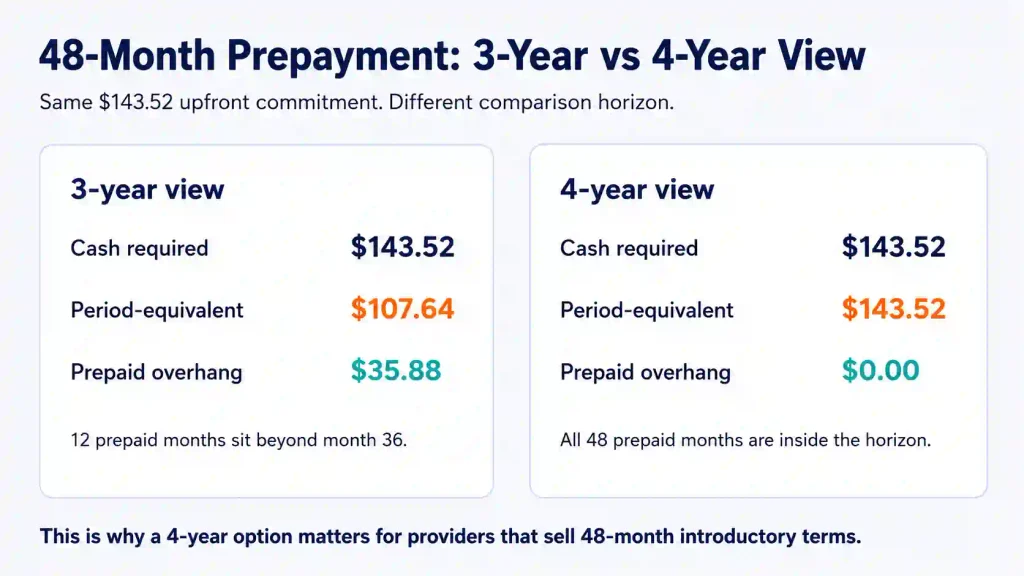
48-Month Prepayment: 3-Year vs 4-Year View
The formula behind the calculator
The model starts with the advertised monthly equivalent and the number of months you must buy at that rate. After the introductory term, it applies the renewal monthly equivalent using the renewal billing cycle you enter. Domains, monthly add-ons, annual extras, one-time fees and an optional tax estimate are then added to the selected horizon.
| Cash-required hosting = intro rate x intro prepaid months + every full renewal billing block that must be paid by the selected horizon. |
| Period-equivalent hosting = intro rate x intro months used inside the horizon + renewal rate x renewal months used inside the horizon. |
| Normalized monthly cost = period-equivalent total / months in the selected horizon. |
The calculator does not guess the renewal term. That matters because a provider can publish different renewal monthly equivalents for monthly, 12-month and 36-month billing. Enter the rate and term as a pair.
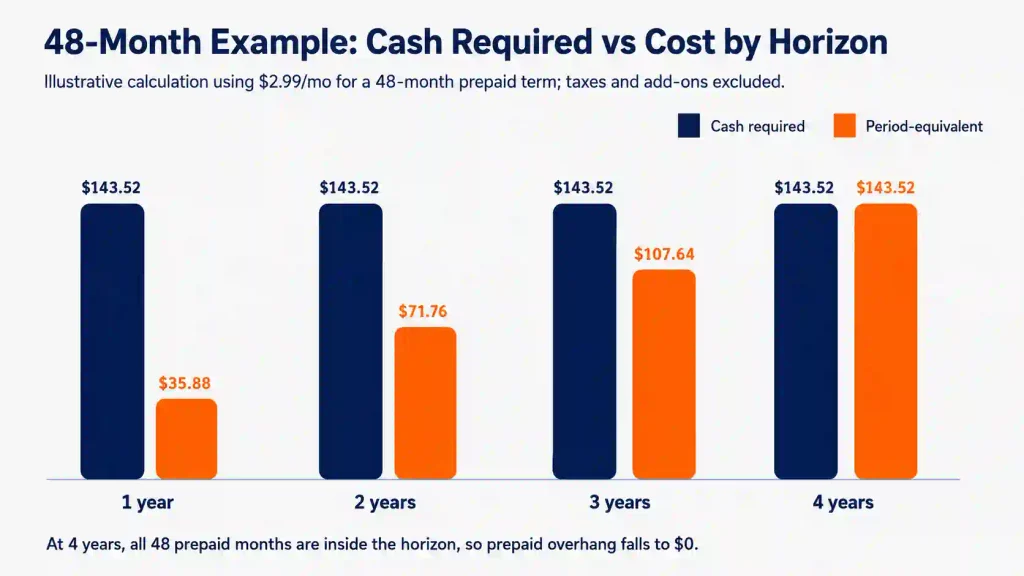
48-Month Hosting Example Across 1 to 4 Years
Current 2026 example: a 48-month Hostinger term
Checked on September 2, 2026, Hostinger’s US web-hosting page listed Premium at $2.99/month for a 48-month term, $143.52 for those 48 months, and a stated renewal monthly equivalent of $10.99. Hostinger also states that plans are paid upfront and that the displayed monthly rate reflects the plan total divided by the number of months.
With no extras or tax, the 48-month introductory payment produces four different interpretations depending on the horizon:
| Horizon | Cash required | Period-equivalent | Prepaid overhang |
| 1 year | $143.52 | $35.88 | $107.64 |
| 2 years | $143.52 | $71.76 | $71.76 |
| 3 years | $143.52 | $107.64 | $35.88 |
| 4 years | $143.52 | $143.52 | $0.00 |
Hosting-only example. No tax or extras. Calculated from the current 48-month introductory price stated on Hostinger’s US page on September 2, 2026.
The four-year view removes the apparent overhang because all 48 prepaid months are now inside the comparison horizon. This is exactly the case a three-year-only calculator cannot represent cleanly.
Current 2026 example: why renewal term changes the result
Bluehost shows a different structure. On September 2, 2026, Bluehost’s pricing page listed Starter at $3.99/month for 36 months and stated a $9.99/month renewal rate for a 36-month term. Its official renewal table listed Starter at $15.99/month for monthly renewal, $11.99/month for a 12-month renewal and $9.99/month for a 36-month renewal.
For a four-year comparison, the billing cycle matters as much as the renewal rate. If you model a 12-month renewal at $11.99/month, the first 36 months cost $143.64 and the next 12 months cost $143.88, so both cash required and period-equivalent cost are $287.52 before extras and taxes.
If you instead model a 36-month renewal at $9.99/month, the renewal monthly equivalent is lower, but the billing block is longer. The four-year period-equivalent hosting cost is $263.52, while cash required by month 48 becomes $503.28 because the model assumes the full 36-month renewal block is paid when it comes due. The $239.76 difference represents 24 prepaid renewal months beyond year four.
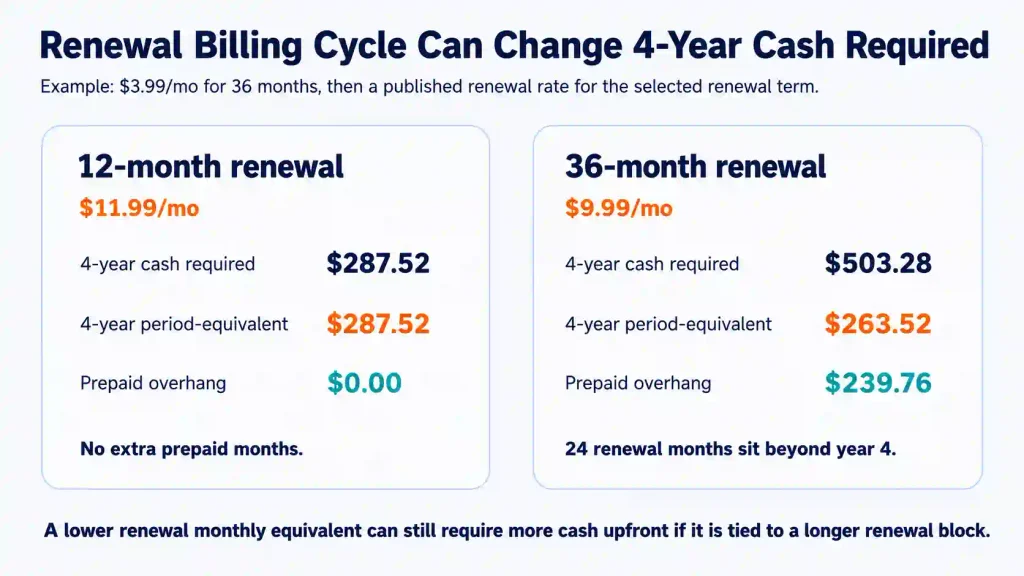
Renewal Billing Cycle Effect on 4-Year Cash Required
How to use the calculator without fooling yourself
1. Start with the exact plan, not the provider brand.
Open the plan you are genuinely considering and record the introductory monthly equivalent, the initial term, the renewal monthly equivalent and the renewal billing cycle. Do not mix a 48-month promo from one plan with a 12-month renewal price from another.
2. Pick the horizon that matches your decision.
Use one year if you are testing a project, two years for a shorter ownership window, three years for a conventional long-term comparison, or four years when a 48-month contract is part of the decision.
3. Add only costs that actually apply.
If SSL, CDN, email or backups are included, leave those fields at zero. If they become paid after a free period, enter the paid amount that belongs in the horizon you are modeling. The calculator is better when your inputs are boring and exact than when they are padded with generic estimates.
4. Read the period-equivalent total first.
This is the main apples-to-apples comparison number because each provider is measured across the same amount of service time.
5. Then read cash required and overhang.
A plan can be cheaper over four years but still require much more cash upfront. The overhang figure makes that commitment visible instead of hiding it inside an average monthly number.
6. Recheck the provider before paying.
Prices, renewal terms and included features change. Treat the calculator as a planning model, then verify the final cart, renewal policy and add-ons on the day you buy.
Costs people commonly forget
The hosting line is only part of the bill. A free first-year domain can renew at a normal registrar price later. Email may be included for a limited period. Backups, security tools, premium CDN features or paid SSL can be optional. Some charges are monthly, some annual and some one-time.
The calculator keeps those costs separate so you can see what is driving the total. If add-ons make up a large share of the normalized cost, that is a signal to compare what competing plans include by default rather than focusing only on the hosting sticker price.
Which horizon should you use?
| Horizon | Best used for | Watch for |
| 1 year | Trials, new projects, uncertain fit | Long prepayment can dominate cash required |
| 2 years | Medium-term budget planning | Renewal may or may not begin inside the window |
| 3 years | Common long-term comparison | 48-month promos can still show prepaid overhang |
| 4 years | 48-month intro terms and longer ownership | Shorter initial terms may trigger renewal blocks |
If you are comparing several hosts, run the same horizon for every plan. A four-year total should not be compared with a competitor’s three-year total. When a provider forces a longer prepaid term, use the cash-required and overhang columns to keep the difference visible.
What this calculator does not tell you
A lower cost does not automatically mean a better host. The calculator does not score speed, uptime, support quality, resource limits, backup policy, migration quality or how well a plan fits your workload. Those are separate buying questions.
If two plans are close on cost, move to the factors that can change site reliability and usability. HostChoices keeps those questions separate in its best web hosting provider comparisons and documents its approach in the hosting benchmark methodology.
The model also assumes the prices you enter remain valid for the periods you specify. It cannot predict future provider price changes, taxes, credits, refunds, currency conversion, regional fees or a plan change you make later.
FAQ
Can I compare a 48-month hosting plan?
Yes. Select the 4-year horizon and enter 48 as the introductory prepaid term. The tool will also show what the same commitment looks like at one, two and three years.
Why can cash required be higher than the four-year cost?
Because a renewal or introductory billing block can extend past month 48. Cash required counts the whole block when it becomes payable; period-equivalent cost counts only the service months inside the four-year horizon.
Should I use the advertised monthly price or the checkout total?
Use both when available. The monthly equivalent helps model the term, while the checkout total is a useful cross-check. If the two do not reconcile, verify taxes, add-ons, free months or other conditions before relying on the result.
Does the calculator store my data?
No personal information is requested. The calculator runs in the browser and does not need to send the values you enter to HostChoices.
Does a lower four-year cost mean the host is better?
No. It only means the modeled ownership cost is lower for the inputs you entered. Performance, limits, support, backups, security and workload fit still need to be compared separately.
Last checked: September 2, 2026. Provider prices and renewal terms can change; verify the exact plan and checkout before purchase.
HostChoices may earn a commission from qualifying purchases made through sponsored links, at no extra cost to you. Commercial relationships do not determine the calculator logic or editorial conclusions.