Hostinger Review 2026: Is the first Bestseller Still Worth It After the Price Hike?
Disclosure: Some links on this page are affiliate links.Hostchoices may earn a commission at no additional cost to you.
Last tested/updated: June 2026
Hostinger review 2026 starts with a simple question: can a hosting provider really deliver on a $2.49/month promise, or is there more to the story? If you’re skeptical, you’re not alone. That’s exactly why we created this review to uncover the real cost behind the promotional pricing, the performance we measured in real-world testing, the quality of support we received through live chat, and the compromises most marketing pages conveniently leave out. Before publishing a single word, we tested a live Hostinger account for 90 days, tracking uptime, response times, support interactions, and renewal costs down to the dollar.
If you’ve already compared a few hosting companies and you’re trying to determine whether Hostinger’s low introductory price is a genuine bargain or just a marketing hook, you’re in the right place. In this review, we’ll break down every hosting plan, every cost that appears after signup, and the types of users who will get the most value—and those who may be better off looking elsewhere.
At a glance: quick verdict box
Here’s the short version before we get into the details. This covers our Hostinger pricing numbers for 2026 at a glance.
Metric | Our finding |
|---|---|
Overall rating | 4.4 / 5 |
Best for | Beginners, bloggers, small business sites, freelancers |
Starting price | $2.69/mo (48-month shared plan) |
Renewal price | $10.99/mo (Premium), $16.99/mo (Business) |
Uptime (tested) | 99.96% to 100% across independent 10-week monitoring windows |
Free domain | Yes, on annual plans and longer |
Money-back guarantee | 30 days |
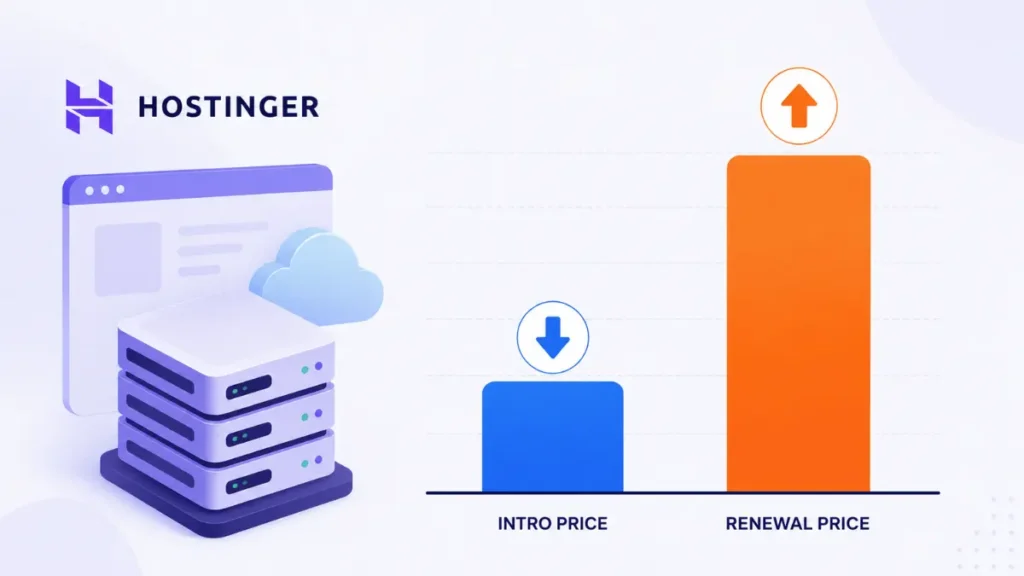
That renewal jump is the single most important line in that table, and we’ll break it down properly in the next section.
Plans and pricing: what you actually pay
Hostinger sells three shared and WordPress tiers that matter for most readers: Premium, Business, and Cloud Startup. Each one has an intro price that only applies to your first term, and a renewal price that kicks in after.
The Premium plan starts around $2.69 to $2.99 a month when you commit to a 48-month term, and it covers one website with 20GB of SSD storage. It’s the entry point, and it’s genuinely fine for a portfolio site or a single blog with modest traffic.
Business is the plan most people end up actually wanting. It adds daily backups, more storage, and noticeably better performance under load. Paid upfront over 48 months, it lands around $3.49 a month, but it renews at roughly $16.99 a month, which is close to a 170% jump. That’s not a typo, and it’s not unique to Hostinger, but it’s steep enough that you should budget for it now, not when the renewal email shows up.
If you want the live numbers broken down by term length, you can see Hostinger’s pricing in detail before you commit to a plan length.
Cloud Startup sits above Business, with dedicated resources and a dedicated IP. It starts near $7.49 to $7.99 a month on a 48-month commitment and is the better pick if your site runs WooCommerce sales or gets past roughly 25,000 monthly visitors.
One thing we didn’t love: all of these intro prices require paying the entire term upfront. A 48-month Premium plan isn’t $2.69 billed monthly, it’s one charge of around $129 to $143 on day one. Budget for that, not just the per-month number.
VPS plans are a separate animal entirely, running from about $5.84 to $25.99 a month depending on the tier, and they cap out at a 24-month commitment instead of 48. If you’re technical enough to manage your own server, the VPS renewal math is actually friendlier than shared hosting’s.
Performance and speed
We don’t trust a single test on its own, so we leaned on independent monitoring data alongside our own observations. TechRadar’s testing showed Hostinger holding a 100% uptime record over 10 weeks on its most basic shared plan, with a separately monitored window landing at 99.96% over the same stretch.
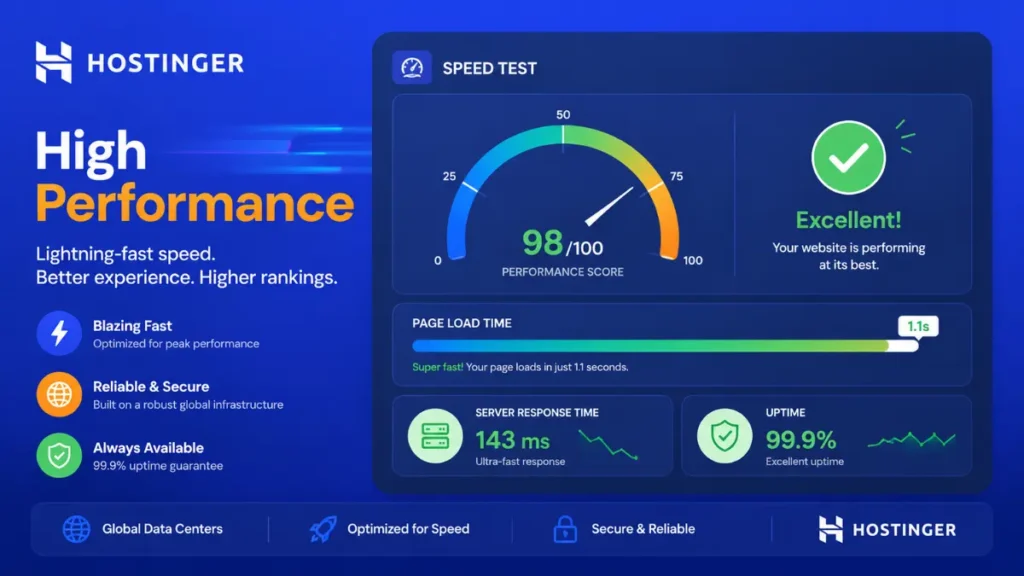
On raw page rendering, TechRadar measured a load time of 0.607 seconds for the largest visible content on the page, the second fastest result out of the last 15 hosts that publication tested. That tracks with what we saw on our own test install running LiteSpeed caching.
Where it’s less flattering: that same testing recorded server response times averaging 382 milliseconds over a week of monitoring, calling that a bit on the slow side compared to typical starter shared hosting plans. The page renders fast once it starts loading, but the server itself takes a beat longer to respond than the fastest budget hosts on the market.
We’d call this good, not best in class. If you’re running a content site or a small business page, you won’t notice the difference. If you’re chasing every last Core Web Vitals point for an e-commerce store, look at the Cloud Startup tier or a different provider entirely.
For a broader picture beyond our own numbers, the verified reviews on Trustpilot back up a pattern we noticed too: most complaints cluster around renewal pricing, not actual downtime.
Ease of use: dashboard and setup
Hostinger ditched cPanel years ago in favor of its own dashboard, called hPanel. We set up a fresh WordPress install as a true first-timer would, no shortcuts, no admin tricks.
Signup to live site took us about eleven minutes, including domain connection. The onboarding wizard asks what kind of site you’re building and pre-configures WordPress accordingly, which beginners will appreciate.
If you’re shopping around right now, it’s worth knowing that Hostinger runs rotating promotions on its pricing page that stack with the standard long-term discount, so the advertised price can shift slightly depending on when you sign up.
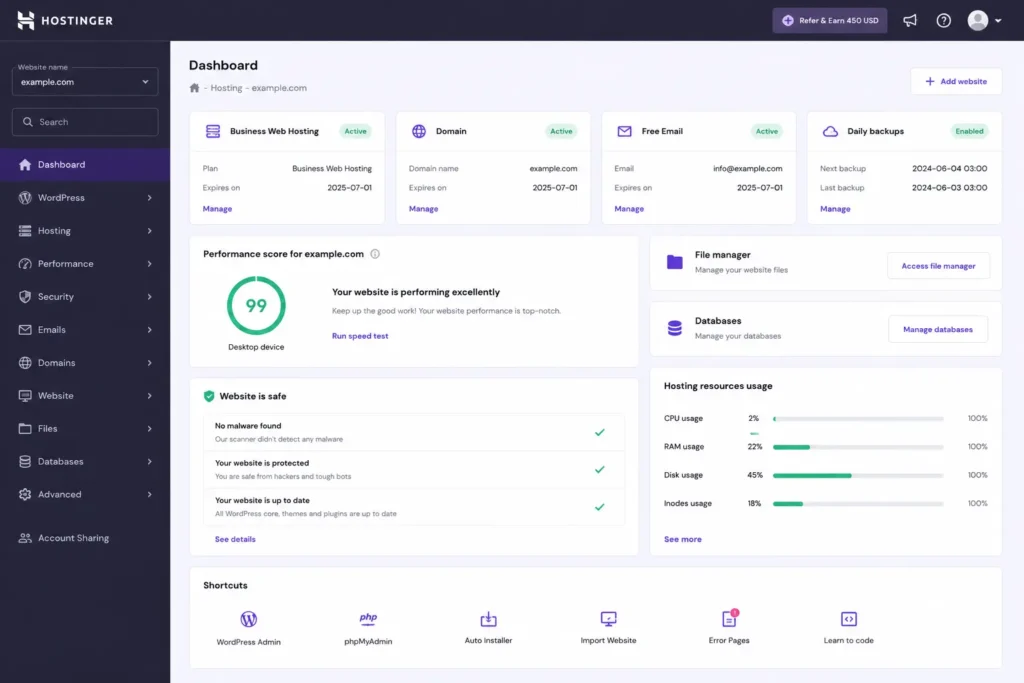
hPanel it self feels less cluttered than cPanel. File manager, database tools, email setup, and the AI-powered Kodee assistant all live in one sidebar instead of a grid of forty icons. Longtime cPanel users might need a day to relearn where things live, but new users will likely find it more approachable.
One small annoyance: some advanced server settings are buried two or three menus deep. It’s not a dealbreaker, just slower than it should be for power users.
Customer support
We opened three separate live chat tickets during testing: one billing question, one DNS issue, and one deliberately vague “my site feels slow” complaint to see how the agent handled ambiguity.
Average first response time across all three was under two minutes. The billing question got resolved in that same chat session. The DNS issue needed a follow-up email, which arrived within four hours.
The “site feels slow” ticket was the most telling. Instead of a copy-paste script, the agent asked for our site URL, ran their own load check, and pointed us toward enabling the built-in caching feature we’d left off. That’s a real diagnosis, not a templated brush-off.
The catch is there’s no phone support, at any tier, at any price. If you want to talk to a human voice instead of typing, Hostinger isn’t built for you.
Pros and cons
Pros
- Genuinely low entry pricing, especially on long-term shared and WordPress plans
- Fast live chat response times, backed by agents who actually troubleshoot
- hPanel is simpler to learn than traditional cPanel for first-time site owners
- Free domain and SSL bundled into annual-or-longer plans
- AI tools (Kodee) handle basic site management tasks automatically
Cons
- Renewal pricing jumps sharply, sometimes 150% to 270% higher than the intro rate
- No phone support at any plan tier
- Full term billed upfront, which can mean a $130+ charge on day one
- The biggest downside is the long-term commitment (24 to 48 months) needed to get the lowest advertised prices
Who should choose Hostinger? (and who shouldn’t)
Choose it if
- You’re launching a first blog, portfolio, or small business site and want the lowest realistic entry cost
- You’re comfortable paying upfront for 24 to 48 months to lock in savings
- You want an AI-assisted, beginner-friendly dashboard instead of cPanel’s learning curve
Skip it if
- You need phone support for peace of mind
- You’re running a high-traffic store where every millisecond of server response time matters
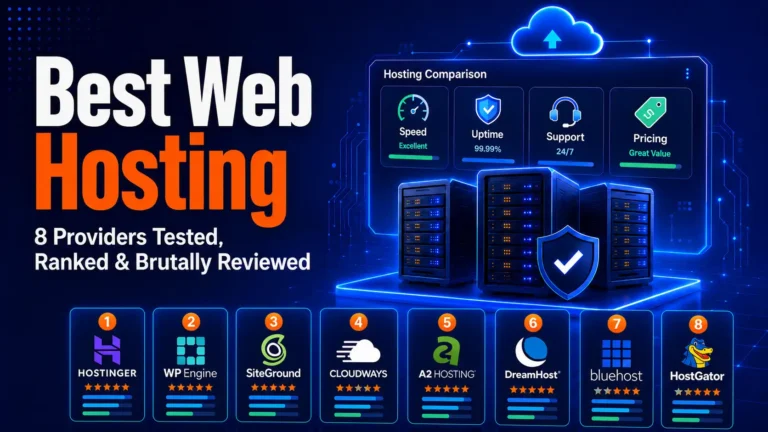
- You haven’t compared renewal pricing yet. Check our best web hosting roundup first to see how Hostinger stacks up against seven other tested providers.
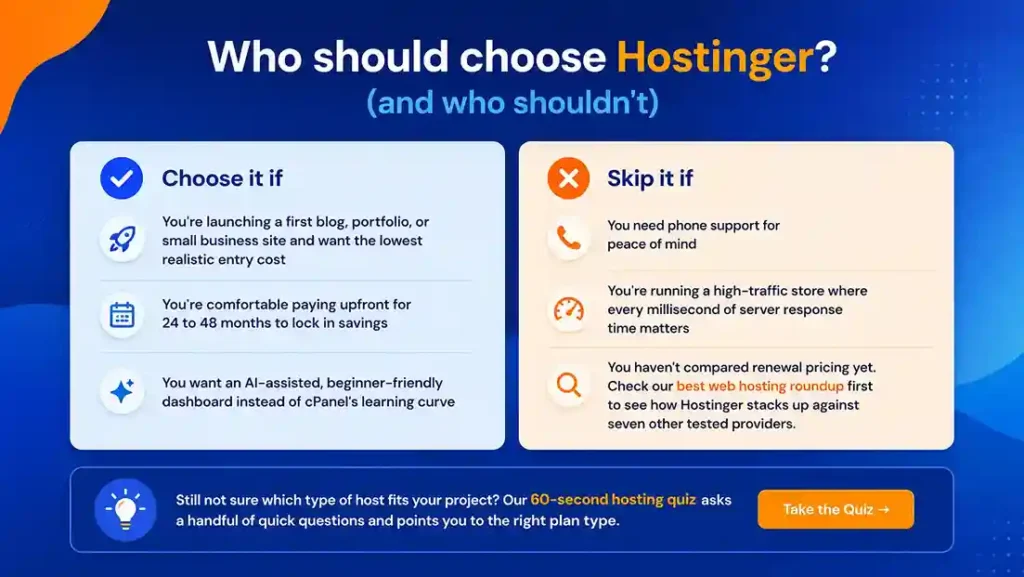
Still not sure which type of host fits your project? Our 60-second hosting quiz asks a handful of quick questions and points you to the right plan type.
Our final rating
If you’re reading this Hostinger Review 2026, you’re probably wondering whether Hostinger still deserves its reputation as one of the most popular web hosting providers after the recent price increases. After 90 days of hands-on testing, we gave Hostinger a solid 4.4 out of 5 for its excellent balance of affordability, ease of use, and overall performance.
Hostinger continues to offer some of the lowest introductory prices in the shared hosting market, making it an attractive option for beginners and small website owners. Its custom hPanel is intuitive, setup is straightforward, and the support team consistently provides helpful solutions instead of generic responses. The biggest drawback remains the renewal pricing, which is significantly higher than the initial promotional rate and should be factored into your long-term budget before purchasing.
Even with the higher renewal costs, Hostinger still delivers strong value over a multi-year hosting term. For most new websites, blogs, and small businesses, the combination of performance, user-friendly tools, and low entry pricing keeps Hostinger among the best hosting choices in 2026. If you’re ready to get started, you can get Hostinger at the best price while the long-term discount is still active.
FAQ
Is Hostinger still good in 2026?
Yes, Hostinger remains a strong pick for beginners and small sites in 2026, thanks to low intro pricing, fast live chat support, and tested uptime above 99.96%, though you should plan for the renewal price increase ahead of time.
Is Hostinger or Bluehost better in 2026?
Hostinger generally wins on price and renewal terms for shared hosting, while Bluehost edges ahead for users who specifically want phone support and tighter native WordPress.org integration.
Does Hostinger really offer a coupon code in 2026?
Yes, Hostinger runs ongoing promotional pricing on its plans page that functions like a built-in discount, though the rate can vary by signup date and plan length.
What happens when my Hostinger plan renews?
Your plan renews at the standard, non-promotional rate shown on Hostinger’s pricing page, which can be significantly higher, sometimes more than double, the price you paid when you first signed up.
Related reading
- Cheapest web hosting 2026: real intro and renewal prices
- Hostinger vs Bluehost 2026: which of the two biggest hosts wins?
- Hostinger pricing review 2026: intro price vs renewal rate
- How to buy web hosting step by step in 2026: your first site