Server cost calculator: compare buying, renting and cloud

Use this server cost calculator to compare buying hardware, renting a dedicated server and using a cloud virtual machine (VM). A fair budget covers the same period and includes electricity, administration, licenses, backups and redundancy as well as the advertised price. Compare the cost attributed to that period with the cash needed to fund full billing terms.
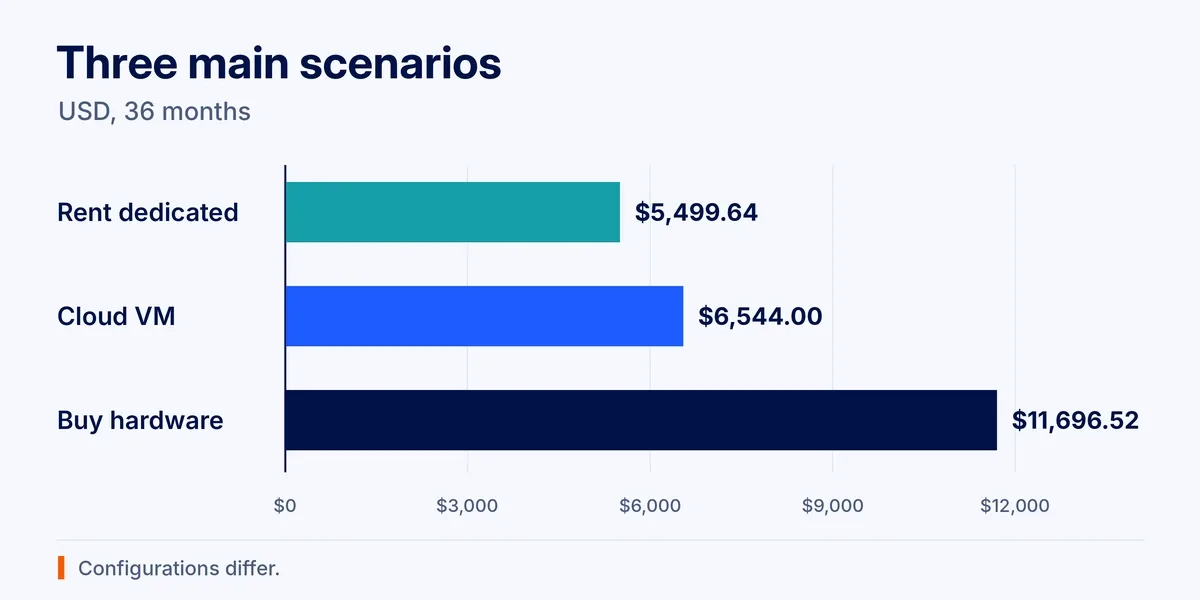
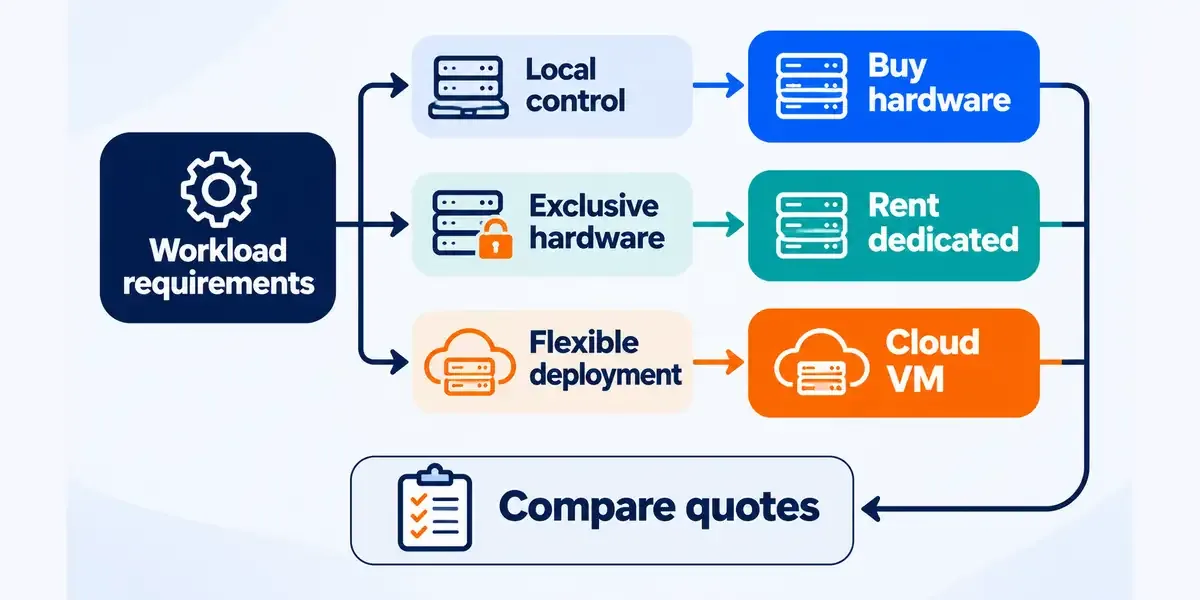
At a glance: In the 36-month examples on this page, dedicated rental costs $5,499.64, a cloud virtual machine costs $6,544.00 and buying hardware costs $11,696.52. These configurations are not performance equivalents; a smaller cloud plan can reverse the ranking. Rent for exclusive physical hardware without ownership, use the cloud for flexible deployment, or buy when local access or operational control justifies the investment.
Pricing checked November 27, 2026. Public US prices in USD and a US electricity reference are used. The totals are modeled budgets before tax, not supplier quotes or measured performance. Prices may change after the research date. Canadian and other international readers should substitute local quotes, currency and electricity tariffs.
How to use the Server cost calculator
Start with your workload: CPU, RAM, usable storage, network traffic, location and recovery requirements. Enter the purchase or hosting quotes for each suitable configuration, choose a common time horizon and include operating expenses. Use the examples below as a starting point, not as a purchase recommendation.
Estimate the total cost of running a server. Compare the same workload and period for buying hardware, dedicated rental and cloud hosting. All amounts are in US dollars, before tax. These are planning estimates, not supplier quotes or performance benchmarks.
Reference examples: 2026-11-27. Dell PowerEdge T160 ($3,349 starting price), Namecheap Xeon E3-1230 v5 ($451.88 first year, $763.88 per renewal year), and AWS Lightsail Linux 16 GB with public IPv4 ($84 monthly base-plan cap). The US commercial electricity reference is EIA September 2026, $0.1427/kWh. Other inputs are illustrative. Check current quotes and local tariffs before buying.
Enter full prepaid invoices, not advertised monthly equivalents. For pay-as-you-go services use an expected monthly charge; the default cloud example uses a full-month cap. Lightsail billing details: standard instances can incur charges while stopped, until deleted. Additional resources may still incur costs.
Use 730 hours for an average budgeting month. A facility multiplier of 1 means no extra facility power; do not count cooling twice. Staff hours may include multiple people.
Reference costs using the default inputs (USD, before tax):
| Horizon | Buy hardware | Rent dedicated | Cloud VM |
|---|---|---|---|
| 12 months | $6,331.51 | $1,691.88 | $2,248.00 |
| 24 months | $9,014.01 | $3,595.76 | $4,396.00 |
| 36 months | $11,696.52 | $5,499.64 | $6,544.00 |
Enable JavaScript in a modern browser to edit inputs and calculate your own comparison.
Calculation method and limitations
Monthly electricity = watts ÷ 1,000 × budgeting hours × facility multiplier × electricity tariff. Monthly operations = electricity + staff hours × loaded hourly rate + software, backup, network, redundancy and other recurring costs.
Allocated hosting = initial invoice × months in initial interval ÷ initial interval + subsequent invoice × remaining months ÷ subsequent interval. Gross allocated cost = purchase + setup + allocated hosting + monthly operations × horizon.
For prepaid terms, funding includes complete invoices covering the horizon; prorated billing assumes payment for the modeled portion only. Initial funding includes purchase, setup and the initial invoice only when prepaid. Future renewals are not necessarily legal obligations. Operating costs include the value of staff time, not just cash invoices. Estimated resale proceeds, if entered, reduce net allocated cost only; they do not reduce the funding requirement.
Inputs and calculations stay in the browser; the calculator does not submit or store them. Taxes, financing, depreciation, future price increases, usage spikes and risk are excluded. Enter realistic aggregate costs for the workload and verify the provider's billing and cancellation terms.
For a prepaid annual plan, enter the entire annual bill and a 12-month term. For a cloud plan billed hourly up to a monthly cap, enter the cap with a one-month modeling interval for a full-month budget. Set local power costs to zero for hosted equipment unless electricity is charged separately. Enter the separate fee only once. Compare the allocated cost with the funding needed for full prepaid terms before signing. For a service billed after use, the first-month budget is not necessarily a payment due on day one.
How much does a server cost? Three public price references
The following examples isolate the purchase or rental charge before adding operating costs. A physical CPU core and a virtual CPU are not interchangeable; storage type, capacity and management scope also matter.
| Model and example | Published charge | Configuration | Check before purchase |
|---|---|---|---|
| Buy: Dell PowerEdge T160 | Starting at $3,349.00 (one-time); same displayed configured price | Xeon E-2436; 16 GB ECC memory module and 1 TB HDD options marked selected; total quantities require confirmation | Final quantities, operating system, warranty and tax |
| Rent: Namecheap Xeon E3-1230 v5 | $451.88 first year; $763.88/year renewal | 4 physical cores, 8 GB RAM, 480 GB SSD; Phoenix, Arizona | Stock, management, panel fees and checkout |
| Cloud: AWS Lightsail Xlarge-16GB Linux with public IPv4 | $84/month base instance cap at listed rate | 4 vCPUs, 16 GB RAM, 320 GB SSD, 6 TB listed transfer | Region-specific transfer allowance, usage, extras and tax |
Namecheap displays $37.66/month for the first annual term, but the amount due for that term is $451.88. Renewal works out to about $63.66/month on an annual commitment. AWS bills this instance by the hour up to its monthly base-plan cap; the example budgets a full month without credits. According to the Lightsail billing FAQ, standard instances continue to incur charges while stopped until deleted. Back up required data before deleting an instance, and budget separately for retained chargeable resources. Dell lists the same $3,349 as the starting and configured price, with free shipping displayed; changes to the hardware or service options can change the quote. No authenticated checkout, coupon or negotiated price is assumed for any example.
For a small public website that does not require its own server operating system or isolated hardware, shared or managed hosting may be a better fit. Compare introductory and renewal hosting prices or see the monthly billing guide for a different service class.
What belongs in the total cost of ownership?
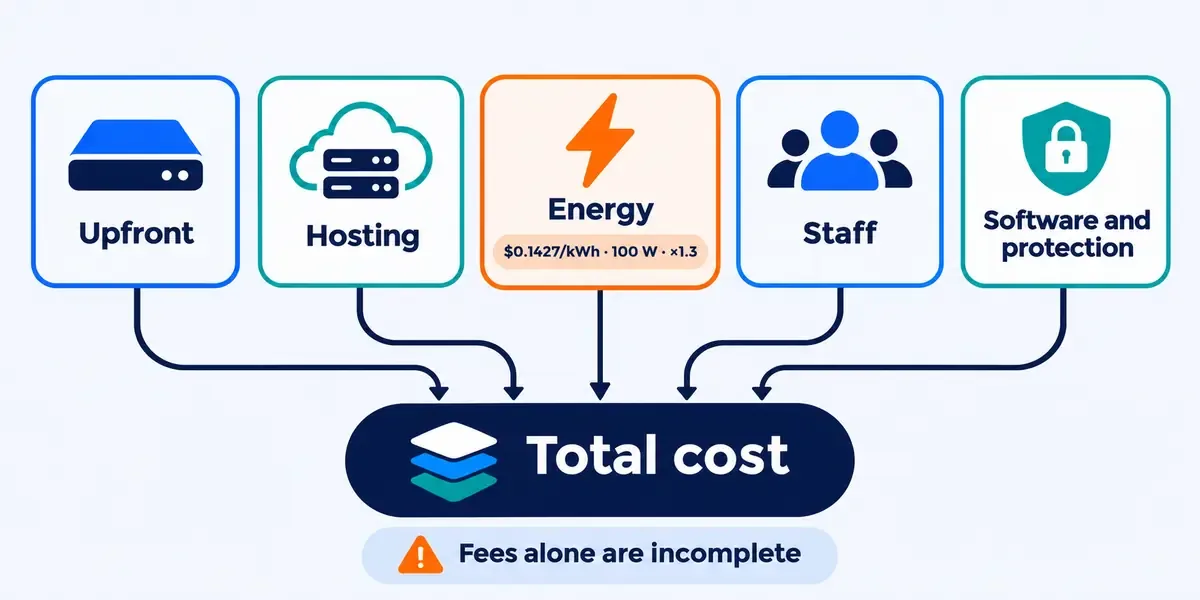
- Upfront: hardware, setup, migration, UPS, spares and initial licenses.
- Hosting: first-term and renewal bills, cloud or colocation charges. Use actual invoice amounts and terms.
- Energy: average IT power draw, electricity tariff and incremental facility overhead. A power supply rating is not actual consumption.
- Staff: monitoring, patching, incident response, restore tests and security. Use a loaded hourly rate that includes employment overhead.
- Software and protection: licenses, backups, extra storage, standby infrastructure and network charges.
Table ES1.A of the US Energy Information Administration’s Electric Power Monthly reports a preliminary September 2026 commercial electricity price of 14.27 cents/kWh, released November 24. It is a national average, not your utility tariff. The ownership example assumes $0.1427/kWh, an average IT load of 100 W and a facility multiplier of 1.3 for incremental overhead. The load and multiplier are hypothetical, not measured. If your meter already includes cooling and other overhead, do not add the same costs again.
For dedicated hosting with a commercial control panel, use the cPanel licensing and administration cost guide to identify additional quote items.
The calculation method and billing assumptions
Monthly electricity cost = (watts ÷ 1,000) × 730 × facility multiplier × electricity price per kWh. The 730-hour budgeting month is 8,760 hours divided by 12, rather than the length of any specific calendar month. The ownership example gives $13.54/month when rounded for display.
Monthly operating cost = electricity + staff hours × hourly rate + licenses + backup + network + redundancy + other recurring costs.
Allocated hosting cost = months within the initial term × first invoice ÷ initial term + remaining months × renewal invoice ÷ renewal term. The initial portion is the smaller of the horizon and initial term; the remaining portion is the greater of zero and the horizon minus the initial term. Use positive term lengths in months whenever a bill is included. If there is no hosting fee, the allocated hosting cost is zero.
Total allocated cost = hardware + setup + allocated hosting cost + monthly operating cost × horizon. Keep full precision during calculations and round the final amount to cents. This is an undiscounted budgeting model; it does not measure accounting depreciation or net present value.
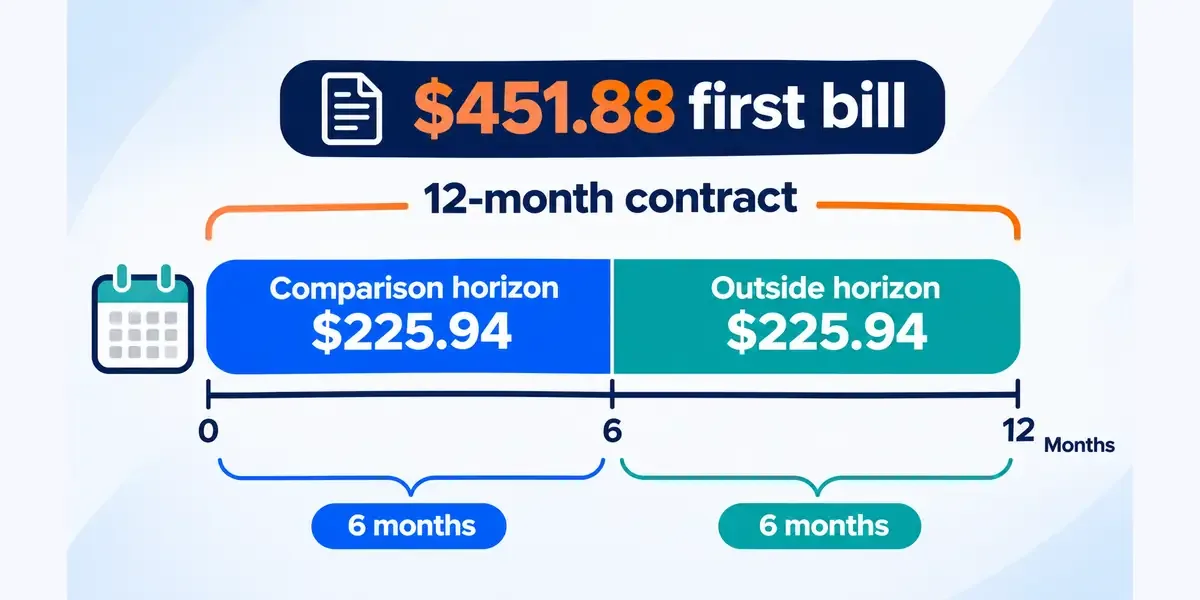
For prepaid plans, the full-term hosting budget is the first invoice plus the renewal invoice multiplied by the number of renewal terms needed to cover the remaining months, rounded up. This assumes uninterrupted service and unchanged renewal rates. It does not establish that a future renewal is legally unavoidable or that the provider offers a refund. For a $451.88 annual first bill, six months of allocated hosting cost $225.94, while the full first bill is $451.88. The $225.94 difference is prepaid service outside the comparison horizon. Hardware, setup and prepaid hosting may be due upfront; wages and metered cloud charges may be paid later.
For an 18-month rental horizon, the allocated hosting cost is $451.88 + ($763.88 × 6 ÷ 12) = $833.82. Paying the first and second annual bills requires $1,215.76 for hosting, leaving $381.94 of prepaid service beyond month 18. With $100 of setup and $95/month in operating expenses, the allocated total is $2,643.82; the full-term funding estimate is $3,025.76. These are cumulative amounts across the period, not an invoice due at the start.
Three 36-month cost scenarios
Each example assumes one primary machine, a $20/month backup budget and labor at $75/hour. Ownership allows two staff hours per month; rental and cloud allow one each. The other inputs below are budgeting assumptions, not measured requirements or quoted add-on prices. No paid license or additional standby service is included.
| Cost input | Buy hardware | Rent dedicated | Cloud VM |
|---|---|---|---|
| Hardware purchase | $3,349 | $0 | $0 |
| Setup | $300 | $100 | $100 |
| First hosting bill | $0 | $451.88 / 12 months | $84 / month |
| Renewal or subsequent bill | $0 | $763.88 / 12 months | $84 / month |
| Monthly electricity | $13.54 (rounded) | $0 | $0 |
| Monthly staff | $150 | $75 | $75 |
| Monthly backup | $20 | $20 | $20 |
| Monthly network | $40 | $0 | $0 |
| Monthly licenses | $0 | $0 | $0 |
| Monthly redundancy | $0 | $0 | $0 |
| Other monthly costs | $0 | $0 | $0 |
| Horizon | Buy hardware | Rent dedicated | Cloud VM |
|---|---|---|---|
| 12 months | $6,331.51 | $1,691.88 | $2,248.00 |
| 24 months | $9,014.01 | $3,595.76 | $4,396.00 |
| 36 months | $11,696.52 | $5,499.64 | $6,544.00 |
| 36-month average per month | $324.90 | $152.77 | $181.78 |
Rental costs $1,044.36 less than the selected cloud example over 36 months. Ownership costs $6,196.88 more than rental. For the three-year rental total, add $100 setup, $451.88 for year one, two renewals of $763.88 and 36 months of operating expenses at $95/month. These are not like-for-like configurations: the rented server lists 8 GB RAM and the cloud bundle lists 16 GB. No matched workload, latency or uptime benchmark is presented.
For a memory-capacity cross-check, the same Namecheap page lists a Xeon E-2234 with 16 GB RAM, four physical cores and a 480 GB SSD at $498.32 for the first year and $711.88/year on renewal. Substituting those invoices while holding the operating assumptions constant gives $5,442.08 over 36 months. Matching memory alone still does not establish equivalent CPU, storage, network or support performance.
A smaller general-purpose Lightsail Linux plan with public IPv4 lists 8 GB RAM, 2 vCPUs and 160 GB SSD at $44/month. With the same $100 setup and $95/month operating budget, its 36-month allocated cost is $5,104.00, or $395.64 less than the 8 GB rental example. This reverses the original ranking, but the smaller cloud plan has fewer virtual CPUs and less listed storage than the dedicated server has physical cores and storage. It is only a viable alternative if the workload fits.
If you only need to compare ordinary web hosting subscriptions, the web hosting cost calculator focuses on subscription costs and billing terms rather than hardware ownership.
Sensitivity: when the result changes
One extra staff hour per month at $75/hour adds $2,700 over three years. A $30/month license adds $1,080, and a $50/month redundancy budget adds $1,800. The personnel cost alone can change the ranking.
The original rental example’s $1,044.36 advantage over the $84/month cloud plan is about $29.01 per month. At $75/hour, about 23.2 minutes of extra monthly administration would consume that advantage. Use this threshold only after confirming that both configurations can serve the workload and that support responsibilities are comparable.
For two options with constant recurring costs, simple payback = additional upfront cost ÷ monthly recurring savings. An extra $3,000 upfront with $100/month in savings pays back in 30 months; if recurring costs are not lower, there is no positive simple payback. When renewal prices change by term, compare cumulative cash flows rather than using a constant monthly savings figure. This example excludes financing, resale value and risk. A procurement decision may need discounted cash-flow analysis as well.
Which model fits a small or large business?
| Choose | Best fit | Check before committing |
|---|---|---|
| Buy hardware | Local applications, data locality, existing IT and facilities | Warranty, UPS, connectivity, spares, recovery and refresh budget |
| Rent dedicated | Sustained workloads needing exclusive physical hardware | Management scope, usable storage, hardware replacement terms, traffic and renewal |
| Cloud VM | Flexible deployments, variable demand or infrastructure automation | vCPU type, storage, transfer, region, backup, scaling and architecture |
A large business should budget for the whole service, not multiply one server by the number of employees. A production database may need replicas, failover, load balancing, protected backups and independent monitoring. Two machines in the same failure domain do not automatically provide high availability. Set the recovery time objective (RTO) and recovery point objective (RPO), which define the target restoration time and tolerable data loss, then obtain quotes for an architecture designed to meet them.
The Lightsail pricing page lists extra charges for block storage, snapshots and load balancing. Estimate those separately when required; do not add a service again if it is already bundled. For rental, confirm who handles monitoring, patches, restores and hardware incidents with the dedicated server management guide.
What the calculator excludes
- Sales taxes, GST/HST, currency conversion, financing, depreciation and resale value unless separately accounted for.
- Future price increases, irregular replacements, discounts or usage spikes beyond the constant input assumptions.
- Partial-month cloud usage, credits, refunds, demand tariffs and contract penalties beyond the full-term budgeting method.
- Unpriced downtime, security incidents, compliance, recovery and migration risks. Assess these separately.
Add the full additional cost of standby capacity and its administration if resilience is required. A zero input means the expense is absent or intentionally excluded; it does not establish that a provider includes the service.
Frequently asked questions
Is it cheaper to buy or rent a server?
Rental has a lower allocated cost than ownership in the main example, but ownership may be preferable when local access or a long equipment lifetime matters. Compare equivalent capacity and operating costs, including labor and energy, over the intended service life.
How much is a dedicated server per month?
The Namecheap E3-1230 v5 example is equivalent to about $37.66/month for the first annual term and $63.66/month on annual renewal. These are allocations of prepaid annual bills, not month-to-month offers. If you need a true monthly contract, request its price and confirm management and licensing fees before purchase.
How do I estimate cloud server costs for a large business?
Inventory compute instances, running hours, storage, transfer, managed databases, monitoring, support, backups and failover. Obtain region-specific quotes for the complete architecture. Include its aggregate recurring bill and any upfront migration or setup costs. A single VM price is not the cost of a production service.
Before you commit
Shortlist configurations that meet your capacity and recovery requirements. Obtain written quotes showing the initial payment, renewal and management responsibilities, then compare both the allocated cost over your chosen horizon and the funding required for full billing terms. Recheck current prices before paying. A cheaper machine is only a better purchase if it can do the job at an acceptable operational risk.