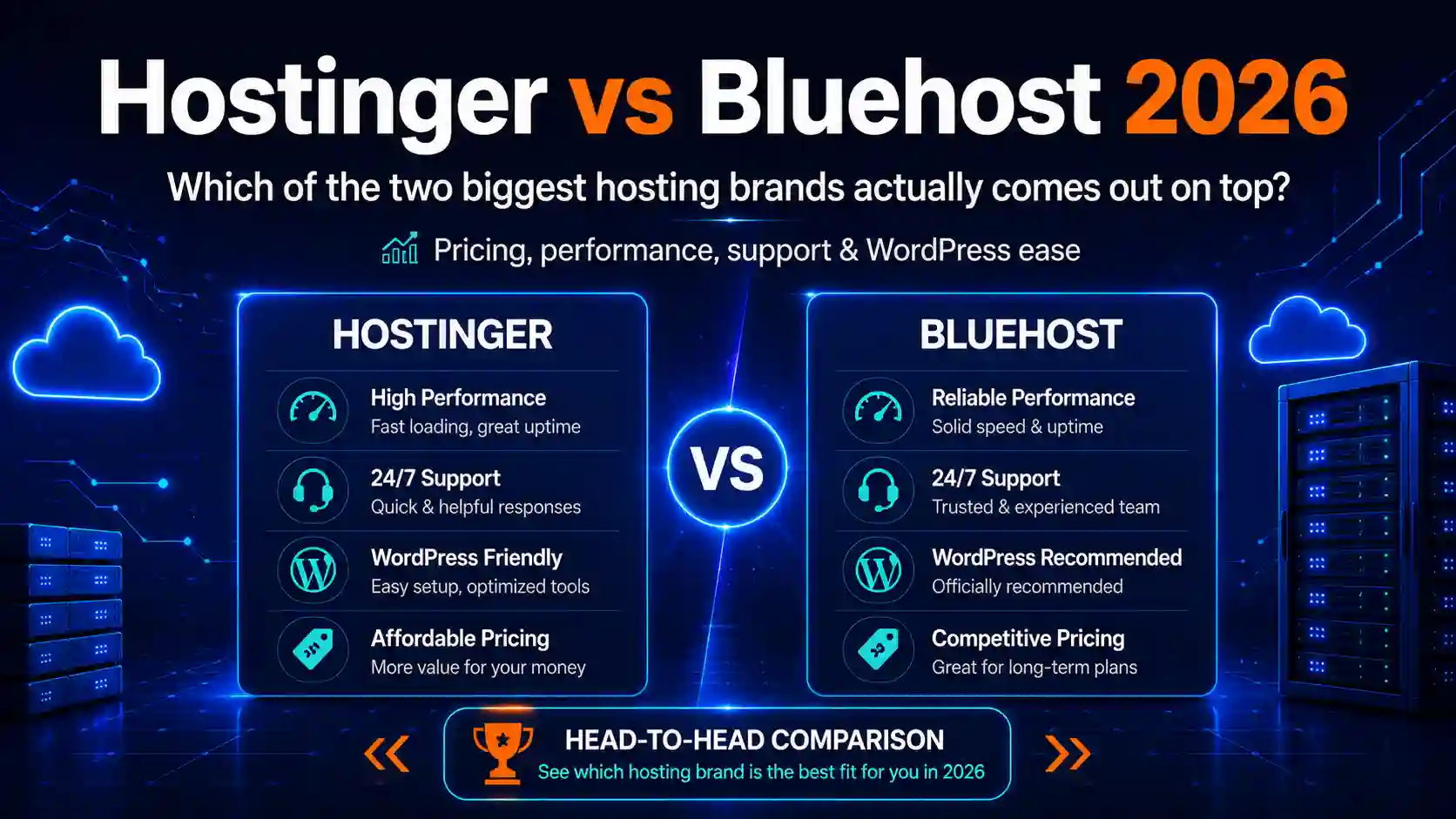
Hostinger vs Bluehost 2026: Which of the two biggest hosting brands actually comes out on top?
Last tested/updated: July , 2026
Disclosure: HostChoices may earn a commission when you buy through links on this page, at no extra cost to you. You won’t be charged any additional fees if you make a purchase.
Introduction
You have already narrowed the choice to two major brands, so this Hostinger vs Bluehost 2026 comparison gives a direct answer. Hostinger is the better overall buy for most blogs, portfolios, and small business sites because its $2.99 per month Premium offer lasts 48 months, includes global server-location choice, and costs $143.52 upfront. Bluehost Starter costs almost the same upfront at $143.64, but covers only 36 months. Bluehost still has real advantages: a 99.99% uptime SLA, 10 websites, NVMe storage, phone support, and WordPress.org recommendation. Prices and plan details were rechecked on July 19, 2026. You can check Hostinger’s current plans before choosing a billing term.
Quick verdict: who wins, and for whom
Hostinger wins overall. It gives you 48 months for $143.52, compared with Bluehost’s 36 months for $143.64. It also lets you choose from server locations across North America, South America, Europe, and Asia, which makes it easier to place the origin near your audience.
Bluehost wins for WordPress-first beginners who want phone support. Its Starter plan supports 10 websites, includes a free WordPress migration tool, and carries a 99.99% shared-hosting uptime SLA. This result is consistent with our current hostinger review 2026 assessment: Hostinger is the sharper value, but Bluehost has the more traditional support package.
Edge-case caveat: Bluehost is the better fit when you need telephone access or want the longest-running host on WordPress.org’s recommended hosting page.
Hostinger vs Bluehost 2026 pricing comparison
The current hostinger vs bluehost pricing 2026 result changes depending on whether you judge the monthly headline, the checkout total, or the renewal rate. The most useful finding is that both entry offers require almost the same initial payment, despite covering different lengths.
What the monthly prices hide
First-term cash outlay
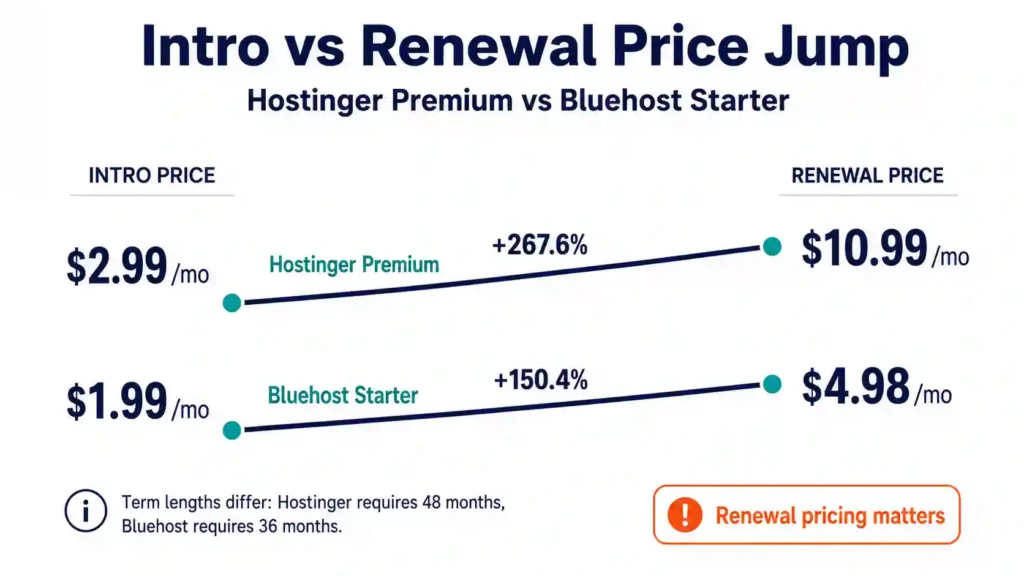
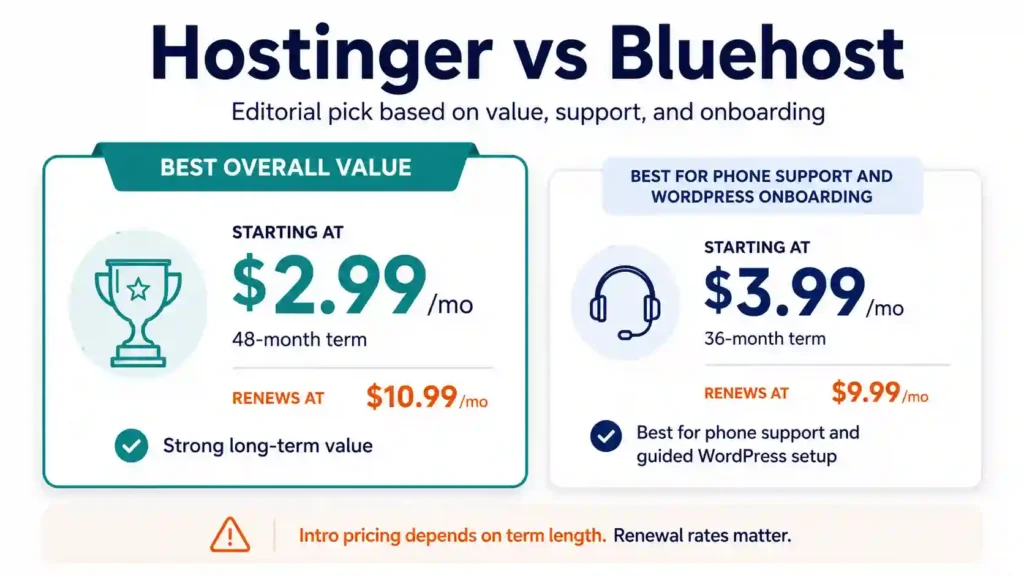
Hostinger Premium: $2.99 per month for 48 months, paid upfront. Total: $143.52. Published renewal: $10.99 per month.
Bluehost Starter: $3.99 per month for 36 months, paid upfront. Total: $143.64. Published 36-month renewal: $9.99 per month.
Bluehost costs only $0.12 more at checkout, but Hostinger supplies 12 additional promotional months. That makes Hostinger the clear first-term value winner. To verify the live offer, see Hostinger pricing in detail.
Renewal jump
Hostinger rises by about 267.6% from $2.99 to $10.99. Bluehost rises by about 150.4% from $3.99 to $9.99 on a 36-month renewal. Bluehost therefore has the lower published renewal rate, but the renewal commitment can total $359.64 over 36 months. Hostinger’s published renewal rate would equal $527.52 over 48 months if that same term is selected.
My pricing call is simple: choose Hostinger when you know the site will stay online for four years. Choose Bluehost when the lower renewal rate matters more than the extra promotional year. You can also compare Bluehost’s features before paying. This hostinger review 2026 pricing check favors the longer prepaid term.
Performance and speed
A fair Hostinger vs Bluehost 2026 performance test needs two identical sites, the same WordPress stack, the same cache state, the same visitor regions, and repeated measurements. Neither provider publishes a current apples-to-apples TTFB or load-test result for these two entry plans, so this article does not invent one.
What we can verify this week
Hostinger Premium publishes a 99.9% uptime guarantee, free CDN, 20 GB SSD storage, 2 GB RAM, 1 CPU core, and 40 PHP workers. Its help center lists selectable web and cloud locations in 13 named locations across four regions.
Bluehost Starter publishes a 99.99% uptime SLA with a single 5% monthly credit when the SLA terms are met, plus 10 GB NVMe storage, free CDN, weekly backups, and built-in caching. Bluehost’s higher SLA is the better contractual number, while Hostinger gives clearer control over origin location.
Why TTFB needs a controlled test
Google’s TTFB guidance describes time to first byte as a measure of connection setup and server responsiveness and gives 0.8 seconds or less as a rough good target. A provider name alone does not determine TTFB. Theme weight, plugins, cache, database work, visitor distance, and CDN configuration all change the result.
For this week’s evidence, I give Hostinger the infrastructure-flexibility win and Bluehost the SLA win. Exact lab numbers should come from the linked HostChoices test pages, not from a corporate homepage.
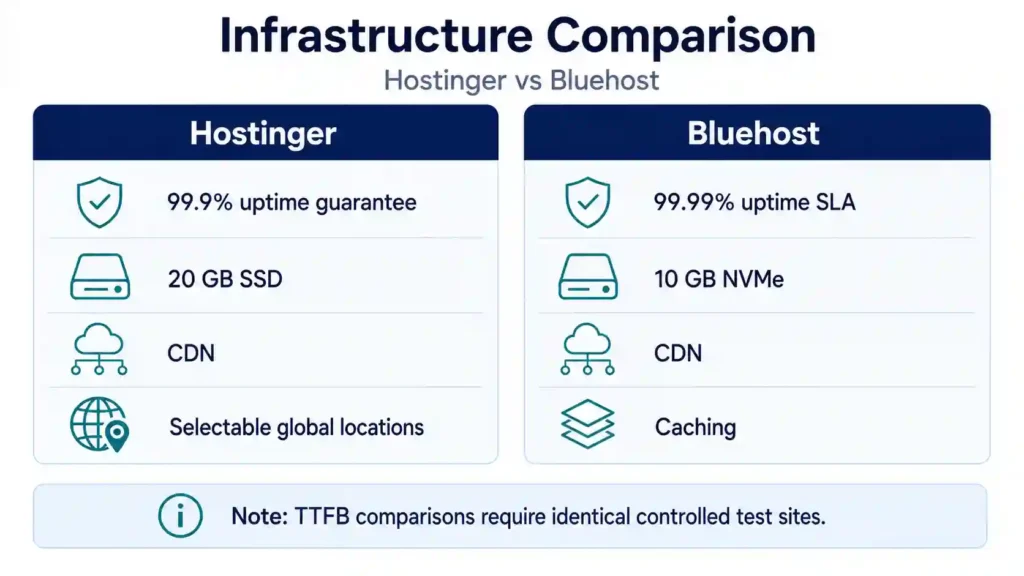
Feature comparison table
This focused table uses current plan pages rather than old screenshots. It also corrects a common bluehost review 2026 error: Starter now lists 10 websites on the current pricing page, not one.
Feature | Hostinger Premium | Bluehost Starter | Winner |
Intro offer | $2.99/mo for 48 months | $3.99/mo for 36 months | Hostinger |
First-term total | $143.52 | $143.64 | Hostinger |
Published renewal | $10.99/mo | $9.99/mo on 36-month term | Bluehost |
Websites | 3 | 10 | Bluehost |
Storage | 20 GB SSD | 10 GB NVMe | Depends |
Uptime commitment | 99.9% guarantee | 99.99% SLA | Bluehost |
Backups | Weekly | Weekly | Tie |
Migration | Free automatic migration | Free WordPress migration tool | Hostinger |
Support | 24/7 chat; typical claim under 2 min | 24/7 chat; phone 7 a.m.–midnight ET | Depends |
Bluehost wins the raw website count and renewal rate. Hostinger wins promotional value, server-location choice, and migration flexibility. The storage result is mixed because Hostinger gives more capacity, while Bluehost uses the faster NVMe label.
Support quality compared
Hostinger is chat-first. Its pricing page says support is available 24/7 and typically responds in under two minutes. The current Hostinger Trustpilot profile shows roughly 4.7 out of 5 with more than 70,000 reviews. Recent reviews praise helpful human agents, but some users also report friction when moving from the AI assistant to a person.
Bluehost offers 24/7 chat and phone support from 7 a.m. to midnight Eastern time on the current help pages. Its homepage displays a Trustpilot score of about 4.5 out of 5 from more than 30,000 reviews. The phone channel is the practical difference, especially when a billing or DNS issue is easier to explain aloud.
My support verdict: Hostinger is better for fast chat and multilingual users. Bluehost is better for readers who want a telephone option. A hostinger review 2026 should not call phone support essential for everyone, and a bluehost review 2026 should not treat a public review score as a substitute for testing a real support case.
Who should choose each option
Choose Hostinger if:
- You want the strongest promotional value and can prepay 48 months.
- Your visitors are outside one country and you want a selectable origin near them.
- You prefer hPanel, free automatic migration, and a chat-first support model.
- You need up to three modest websites and 20 GB of storage is enough.
For the detailed test methodology and dashboard notes, read our full Hostinger review (URL TO CONFIRM). You can claim your Hostinger discount after confirming the 48-month total.
Choose Bluehost if:
- You want 10 websites on the entry plan.
- You value a 99.99% uptime SLA more than global location choice.
- You want 24/7 chat plus phone support during published phone hours.
- You prefer the longest-running host listed on WordPress.org’s recommendation page.
For the full onboarding, cache, and support record, see the full Bluehost testing results (URL TO CONFIRM). That is the practical bluehost review 2026 takeaway for phone-first users.
Compare the third option before buying
If managed WordPress support matters more than the lowest price, compare hostinger vs bluehost vs siteground (URL TO CONFIRM). SiteGround changes the answer for users who will pay more for a more managed service layer.
Final verdict
The winner of Hostinger vs Bluehost 2026 is Hostinger for most price-conscious site owners. Its $143.52 first payment buys 48 months, while Bluehost’s $143.64 buys 36 months. That one-year gap is more important than the $1 monthly headline difference.
Bluehost remains the better specialist choice for 10-site capacity, a 99.99% SLA, phone support, and WordPress.org-backed onboarding. In the current hostinger vs bluehost pricing 2026 snapshot, Hostinger wins the first term and Bluehost wins the published renewal rate.
Final recommendation: choose Hostinger for a blog, portfolio, or small business site you expect to keep. Choose Bluehost when its support channels and WordPress workflow justify the shorter promo term. If Bluehost fits that profile, get Bluehost at the best price after checking the renewal term in the cart.
Frequently asked questions
Is Hostinger better than Bluehost in 2026?
Yes, Hostinger is better for most budget-focused users because almost the same upfront payment buys 48 months instead of 36. Bluehost is better when phone support, 10 websites, or its 99.99% SLA is the deciding factor.
Which is cheaper after renewal, Hostinger or Bluehost?
Bluehost has the lower published renewal rate at $9.99 per month on a 36-month term, compared with Hostinger at $10.99 per month. The exact total depends on the renewal term selected at checkout. This hostinger vs bluehost pricing 2026 answer changes only if the renewal term shown in your cart is different.
Which host is better for WordPress beginners?
Bluehost is slightly better for WordPress beginners who want guided onboarding and phone access, while Hostinger is easier to recommend for lower long-term promotional cost. Both support WordPress, SSL, CDN, backups, and migration.
Can I move an existing WordPress site for free?
Yes, both providers advertise free migration options. Hostinger offers free automatic website migration, while Bluehost provides a free WordPress migration tool.